The State of Denver Industrial Market Trends in 2025
As 2025 draws to a close, Denver industrial market trends have demonstrated both challenges and opportunities, navigating one of the most complex years in over a decade. The combination of rising vacancy, slowing leasing velocity, and recalibrating investment metrics has tested owners, tenants, and investors alike. Yet amid these shifts, strategic opportunities have emerged — especially for those who act with data-backed precision.
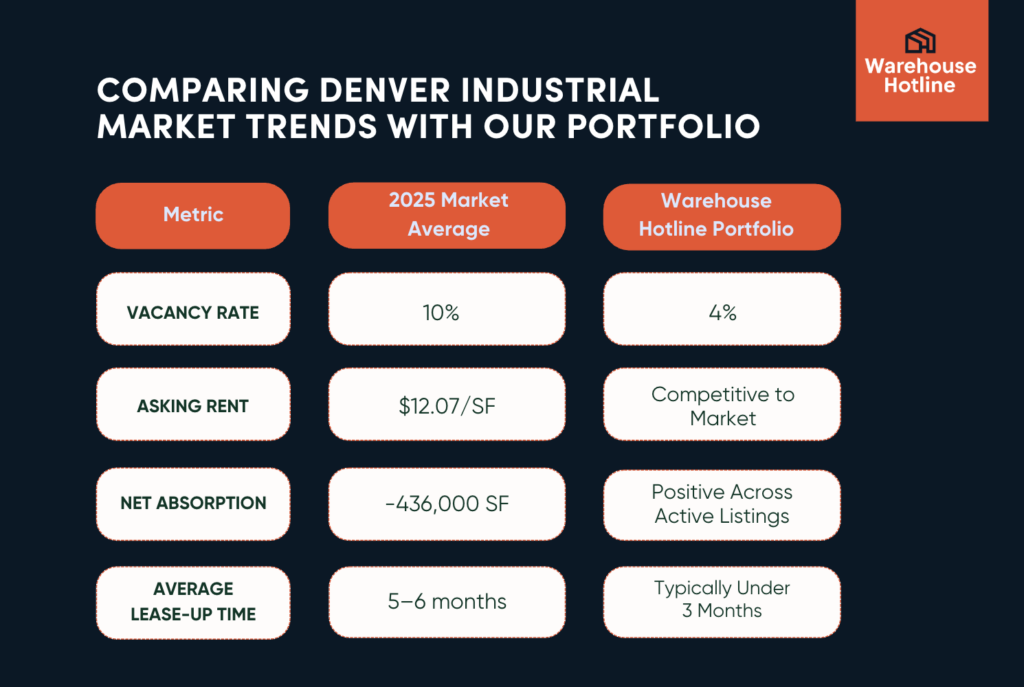
Vacancy has climbed to roughly 10%, up from 7% in early 2024, marking the highest level in ten years. Net absorption sits at negative 436,000 SF, meaning more space is returning to the market than being leased. NNN costs, particularly insurance, continue to pressure operational budgets, prompting tenants to reassess space requirements and layouts.
“We’re seeing tenants think more strategically about how they use space,” said Aviva Sonenreich, Managing Broker at The Warehouse Hotline. “Shorter terms, flexible layouts, and properties that can support hybrid uses — like combining warehouse, light manufacturing, and office — are gaining the most traction.”
Asking rents have flattened at $12.07/SF, with forecasts suggesting further softening through early 2026. Leasing timelines now average five to six months, reflecting cautious tenant decision-making and slower deal velocity across most submarkets.
Investment and Sales Activity
On the investment side, the Denver industrial market continues to recalibrate after years of aggressive growth. Average sale pricing sits at $165/SF, compared to asking prices of $179/SF, resulting in an 8% gap from ask to close. Cap rates have increased to 7.9%, creating a buyer-favored environment for disciplined investors.
According to Sonenreich:
“Investors are prioritizing stability — long-term renewals, solid credit tenants, and reliable cash flow over aggressive rent growth. The fundamentals are back in focus, which is good for the market.”
For property owners, these shifts underscore the need for precision and a data-driven strategy. Owners who maintain occupancy through this transition are positioned to outperform. Denver industrial market trends reward those who anticipate tenant needs and understand what drives each submarket.
How Stakeholders Can Navigate 2025’s Market Shifts
Even in a softer market, proactive strategies can protect and grow value. Here’s how stakeholders can approach the current environment:
For Owners: Protect Income and Strengthen Value
- Price for today’s market, not the peak. Use current absorption and comparable metrics.
- Get creative with deal structures — offer shorter terms, TI packages, or step-up rent schedules.
- Invest in marketing — updated photos, virtual tours, and proactive outreach reduce lease-up time.
For Tenants: Negotiate From Strength
- Use data to support offers, referencing current lease rates and vacancy trends.
- Incorporate flexibility — renewals, expansion clauses, early termination rights.
- Request concessions — free rent, TI, and operating expense caps provide operational relief.
For Investors: Look Beyond Headlines
- Focus on functional assets — clear heights, dock access, and well-located smaller bays remain in demand.
- Leverage rising cap rates as strategic entry points; 7–8% caps paired with improving fundamentals offer upside.
- Target under-managed properties — assets with higher vacancies often yield the best value-add potential.
Outperforming the Market: Warehouse Hotline Portfolio
While Denver’s broader market contends with 10% vacancy, Warehouse Hotline’s portfolio operates at roughly 4%. This gap demonstrates how proactive leasing, disciplined management, and data-backed decision-making outperform broader market conditions.
Key priorities include:
- Operational focus: Remaining responsive to tenant needs, particularly around NNN costs and efficiency improvements.
- Strategic renewals: Retaining tenants with realistic rates and strong communication.
- Targeted marketing: Positioning properties aggressively within tenant-favorable segments.
What the Data Shows
These results highlight that Denver industrial market trends present challenges but can be mitigated through focused strategy and portfolio management. Even amid elevated vacancy, hands-on management preserves value and drives performance above market averages.
Market Direction for 2026
Looking ahead, Denver industrial market trends point toward gradual stabilization. With limited new development, vacancy is expected to plateau before improving later in 2026.
“As cap rates normalize and tenant demand steadily rebounds, properties that have remained leased or were strategically acquired during this correction cycle will be positioned to lead the recovery phase,” said Sonenreich.
“We’re moving past post-pandemic volatility and returning to fundamentals. The deals being made today will define the next growth cycle.”
Strategic Insight
Even in a softening market, the opportunity belongs to those who adapt quickly. Across properties managed by Warehouse Hotline, vacancy remains at 4%, less than half the market average. This reinforces that targeted leasing, disciplined management, and data-driven decisions consistently outperform broader conditions.
For owners, tenants, and investors, aligning with localized expertise and real-time insights will be critical in navigating Denver industrial market trends through 2026 and capturing emerging opportunities.
Q1: Why did Denver industrial vacancy rise in 2025?
A1: Slower leasing, cautious tenant decision-making, and a limited construction pipeline contributed to vacancy reaching roughly 10%, the highest in a decade.
Q2: How have rents changed this year?
A2: Asking rents have largely flattened at $12.07/SF, with landlords offering concessions rather than reducing published rates. Modest growth is expected in 2026.
Q3: What does rising cap rates mean for investors?
A3: With cap rates averaging 7.9%, disciplined investors can find entry points in well-located, functional industrial assets for long-term yield.
Q4: How is Warehouse Hotline outperforming the market?
A4: Through proactive leasing, strategic renewals, and operational focus, the portfolio maintains just 4% vacancy — far below the market average.
Q5: What opportunities exist for 2026?
A5: Limited new supply and stabilizing tenant demand create an environment where functional, well-positioned properties are likely to appreciate, rewarding data-driven decisions.
Follow Aviva and The Warehouse Hotline for exclusive insights, expert tips, and behind-the-scenes content on
- Website: The Warehouse Hotline
- Youtube: Aviva Real Estate
- TikTok: @avivarealestate
- X (Twitter): Aviva – Denver – Warehouse
- Facebook: Aviva Sonenreich’s Denver Commercial Real Estate | Warehouse Hotline
- LinkedIn: Aviva Sonenreich | Warehouse Hotline
- CRE Secrets: Spotify | Apple