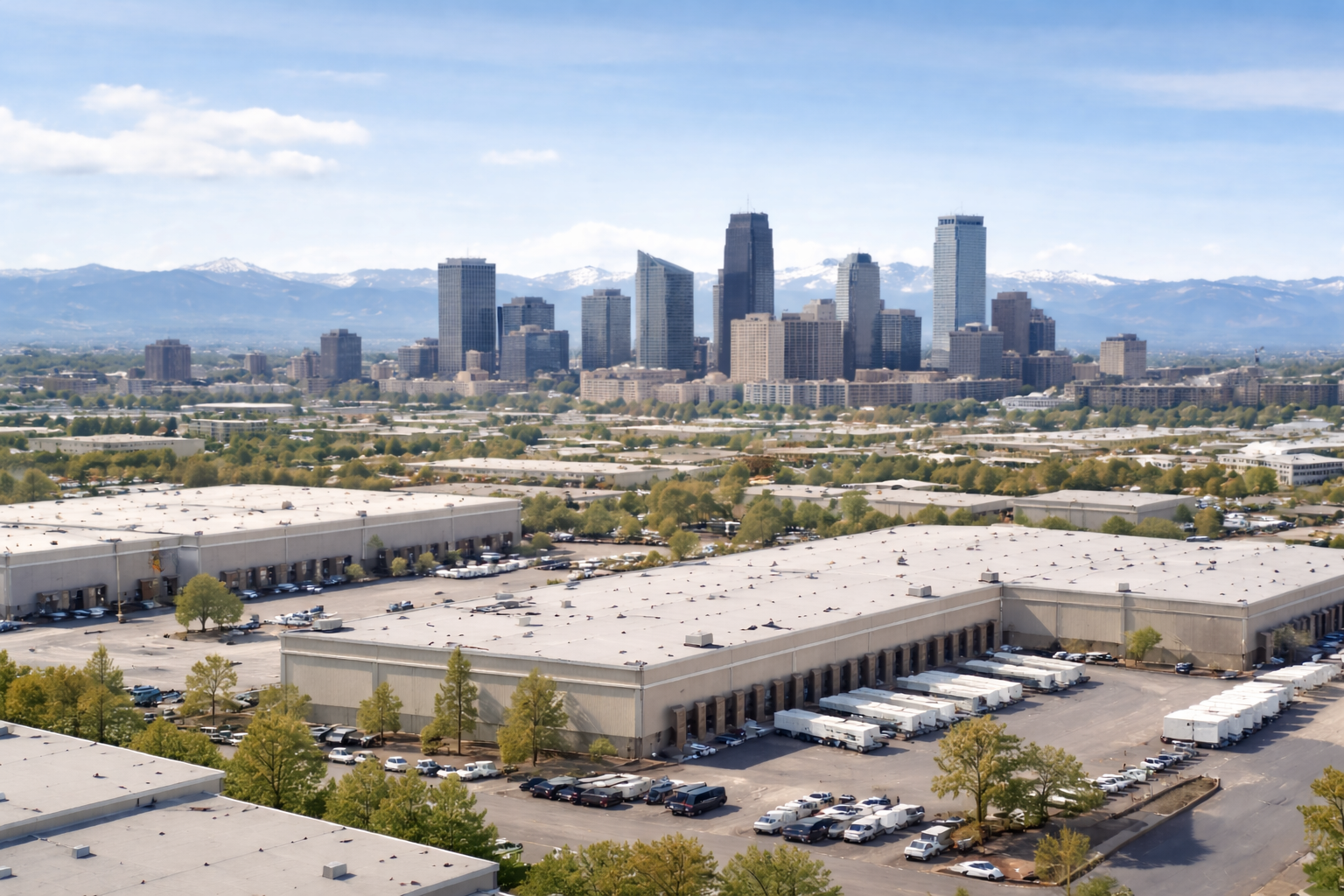
Denver industrial market trends shifted materially between 2022 and 2024 as industrial development surged across major U.S. markets, including Denver. Elevated construction activity reshaped vacancy and absorption metrics, particularly within large-format distribution product. As capital markets tightened and construction costs increased, development activity began to moderate, signaling a return to more disciplined underwriting and selective project starts.
Vacancy pressure within Denver industrial market trends is not evenly distributed across the sector. Larger bulk facilities account for a disproportionate share of available space, while smaller industrial formats — especially those embedded within established urban and suburban corridors — continue to benefit from functional demand and constrained new supply.
Recent vacancy increases have been driven primarily by new completions rather than broad-based demand erosion. Leasing activity remains more durable in select submarkets and size categories, reinforcing that Denver industrial market trends are increasingly segmented by asset type and location rather than moving uniformly.
What’s Working Today and Carrying Into 2026
Between 2022 and 2024, industrial development surged across major U.S. markets, including Denver, reshaping vacancy and absorption metrics. As capital markets tightened and construction costs rose, development activity began to moderate, signaling a shift toward more disciplined underwriting and selective project starts.
Vacancy pressure is not evenly distributed across the industrial sector. Larger bulk facilities account for a disproportionate share of available space, while smaller industrial formats — particularly those embedded within established urban and suburban corridors — benefit from functional demand and limited new supply.
In Denver, recent vacancy increases have been driven primarily by new completions rather than broad-based demand erosion. Leasing activity remains more durable in select submarkets and size categories, and speculative development pipelines have moderated meaningfully across the metro area.
Evidence Shaping the 2026 Industrial Outlook
1. Small-Bay & Infill Industrial Remains Relatively Tighter
Across national industrial research, smaller industrial properties — generally under approximately 100,000 square feet — continue to outperform larger-format assets on a relative basis. These properties tend to serve local and regional users that prioritize proximity to customers, access to labor, and operational flexibility.
Within the context of Denver industrial market 2026 opportunities, demand for small-bay and mid-sized industrial space remains comparatively steady. Limited land availability, zoning constraints, and the economics of ground-up construction have curtailed new supply in this segment, helping preserve tighter fundamentals even as overall vacancy has risen.
2. Slower New Supply Supports Existing Inventory
As industrial construction slows nationally and locally, existing industrial inventory faces reduced competitive pressure from new deliveries. In many Denver submarkets — particularly close-in and infill locations — future industrial development is further constrained by land scarcity and competing land uses.
These conditions reinforce long-term supply discipline and support occupancy stability for functional, well-located assets. Properties that offer efficient layouts, flexible configurations, and modernized infrastructure appear better positioned as the market continues to recalibrate.
Evidence Shaping the 2026 Industrial Outlook
Several consistent themes emerging across national research and local market data continue to shape Denver industrial market trends heading into 2026:
- Industrial performance is increasingly segmented by asset size and location, rather than moving uniformly.
- Construction activity has slowed materially from peak levels, reflecting tighter capital conditions and more selective development strategies.
- Denver vacancy has risen from historic lows but shows signs of stabilization that vary meaningfully by submarket and product type.
Together, these dynamics support an outlook in which small-bay and infill-oriented industrial properties appear comparatively better positioned as broader Denver industrial market trends continue to rebalance.
How Denver’s Industrial Submarkets Are Actually Performing
Denver industrial market trends are not monolithic. Performance varies meaningfully by submarket, asset size, tenant profile, and functional utility. While headline market statistics provide helpful context, real-world outcomes are increasingly shaped at the corridor and building level.
This submarket snapshot translates broader Denver industrial market trends into practical, on-the-ground implications for owners, tenants, and investors operating across the metro area — from infill service-oriented buildings to large-format distribution and logistics facilities.
1. I-70 Corridor (Central & East Denver)
Limited remaining infill land, proximity to population centers, and consistent service-oriented demand continue to support occupancy within Denver industrial market trends.
- Owners: Focus on tenant retention, building efficiency, and adaptability for last-mile, service, and light industrial users.
- Tenants: Plan renewals early to secure functional space in supply-constrained locations.
2. I-25 Corridor (North & Central Denver)
Competing land uses, labor access, and transportation connectivity restrict new industrial development in many nodes.
- Owners: Scarcity supports long-term occupancy when assets remain operationally competitive.
- Tenants: Workforce access and timing are increasingly critical factors in site selection.
Central Denver / Infill Areas
High barriers to new construction and limited land availability create durable scarcity within Denver industrial market trends.
- Owners: Flexible layouts, clear heights, and efficient loading configurations drive leasing performance.
- Tenants: Competition favors adaptable users willing to optimize space usage.
3. North Metro (Commerce City, Thornton)
This region offers a broader mix of building sizes and vintages, including both large-format warehouses and smaller service-oriented facilities.
- Owners: Functional relevance and tenant alignment matter more than asset size alone.
- Tenants: Location, access, and operational fit increasingly guide decisions as availability varies by product type.
Positioning Industrial Assets for 2026 Decision-Making
As Denver industrial market trends continue to evolve, decision-making requires moving beyond generalized narratives and focusing on how specific assets perform within their intended use cases.
Drawing on active brokerage, ownership, and advisory work across both small-bay and large-format industrial assets, Aviva Sonenreich emphasizes that opportunity in 2026 is less about chasing a single “winning” asset type and more about positioning buildings correctly within their segment.
- Owners:Prioritize tenant retention, operational efficiency, and flexibility — whether managing sub-100,000 SF service-oriented buildings or larger distribution and logistics facilities. Buildings that align with tenant operations, loading needs, and labor access remain best positioned to maintain occupancy.
- Tenants:Begin space planning early. Infill availability remains limited, while larger facilities may offer options but require careful evaluation of location, operating costs, and long-term functionality.
- Investors: Evaluate opportunities at the segment and submarket level, not solely through aggregate vacancy or national headlines. Performance varies meaningfully between infill service assets, mid-sized industrial buildings, and large-format warehouses, even within the same metro area.
Understanding how different industrial segments perform — not just headline vacancy — is increasingly central to interpreting Denver industrial market trends as the market normalizes.
What Matters Most Heading Into 2026
- Denver industrial market trends are driven by segmentation across asset size, location, and functional use — not a single market narrative.
- Slowing construction reduces competitive pressure on existing inventory when assets remain operationally relevant.
- Land constraints and zoning limitations amplify national trends, particularly in close-in and established corridors.
- Strategic positioning matters more than asset size alone heading into 2026.
Q1: What are the current Denver industrial market trends?
A1: Denver industrial market trends show higher vacancy driven by recent new supply, with stronger performance in small-bay and infill assets compared to large-format bulk facilities.
Q2: Why has vacancy increased in the Denver industrial market?
A2:Vacancy in Denver has risen primarily due to new completions rather than a broad decline in tenant demand, with impacts varying by submarket and building size.
Q3: Are small-bay industrial properties performing better in Denver?
A3: Yes. Within Denver industrial market trends, small-bay and infill industrial properties generally show tighter fundamentals due to limited new supply and consistent local demand.
Q4: How do Denver industrial market trends differ by submarket?
A4: Denver industrial market trends vary significantly by corridor, with close-in and infill submarkets benefiting from land constraints, while outer submarkets experience more exposure to new supply.
Q5: What should owners and investors watch heading into 2026?
A5: Owners and investors should focus on asset positioning, tenant alignment, and submarket dynamics rather than relying solely on headline vacancy within Denver industrial market trends.
Follow Aviva and The Warehouse Hotline for exclusive insights, expert tips, and behind-the-scenes content on
- Website: The Warehouse Hotline
- Youtube: Aviva Real Estate
- TikTok: @avivarealestate
- X (Twitter): Aviva – Denver – Warehouse
- Facebook: Aviva Sonenreich’s Denver Commercial Real Estate | Warehouse Hotline
- LinkedIn: Aviva Sonenreich | Warehouse Hotline
- CRE Secrets: Spotify | Apple