
What Is a Triple Net Lease?
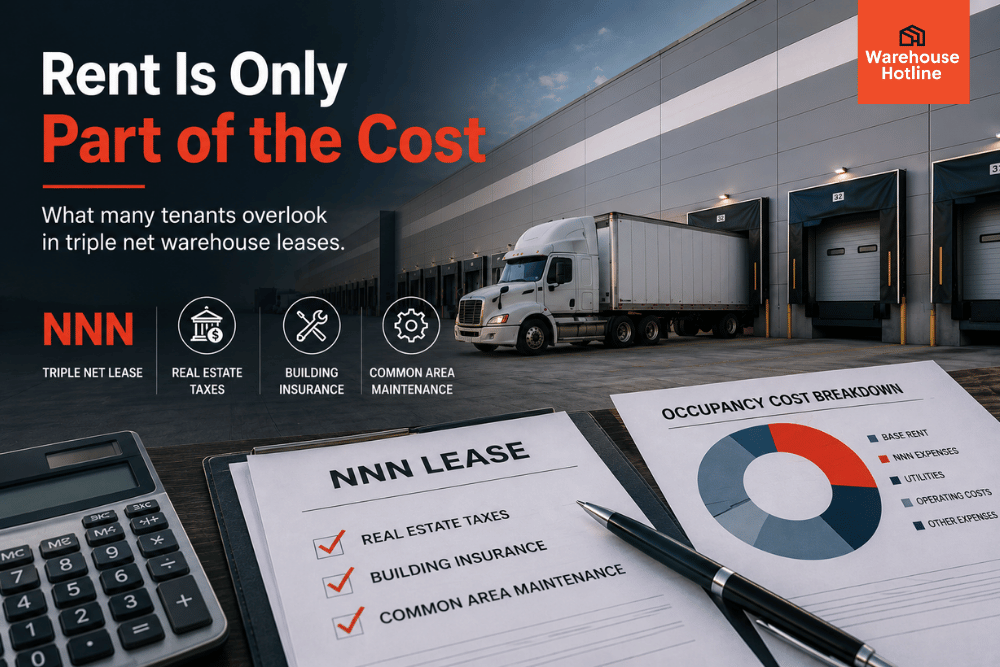
A triple net lease (NNN lease) is a commercial lease structure where the tenant pays base rent plus property taxes, insurance, and common area maintenance (CAM) expenses. Triple net leases are commonly used in industrial real estate, retail properties, and warehouse leasing because they create clearer allocation of operating expenses between landlords and tenants.
In many warehouse leasing situations, rental rate alone does not reflect the true occupancy cost of a property. Operating expenses, maintenance exposure, insurance costs, and tax reassessments can all materially affect long-term lease economics.
This short video explains how triple net leases work, why tenants pay NNN expenses, and how operating costs affect warehouse occupancy decisions.
Key Takeaways
- Triple net leases require tenants to pay rent plus operating expenses.
- NNN expenses typically include taxes, insurance, and CAM charges.
- Triple net leases are common in warehouse leasing and industrial real estate.
- Occupancy cost matters more than rental rate alone.
- Property tax reassessments can significantly affect NNN expenses over time.
- Warehouse functionality increasingly affects long-term operational performance.
- Experienced tenants often negotiate protections around CAM increases and expense allocations.
- Industrial landlords often prefer NNN structures because they improve expense recovery, operational transparency, and NOI predictability.
What Does NNN Mean in Real Estate?
NNN stands for “net, net, net,” referring to the three primary operating expenses commonly paid separately from base rent:
- property taxes
- building insurance
- common area maintenance (CAM)
This is why triple net leases are often referred to as NNN leases.
In a triple net lease structure, tenants pay base rent in addition to these operating expenses rather than paying a single bundled rental rate.
In commercial real estate, especially industrial real estate and warehouse leasing, NNN structures help separate operating expenses from rental rates so both landlords and tenants can more clearly evaluate long-term occupancy costs and property operating expenses.
What Is Included in a Triple Net Lease?
A triple net lease usually includes:
- base rent
- property taxes
- insurance
- CAM charges
Depending on the property and lease structure, additional operating expenses may also apply.
Typical NNN Expenses
| Expense Type | Commonly Included |
|---|---|
| Property Taxes | Yes |
| Building Insurance | Yes |
| Common Area Maintenance | Yes |
| Landscaping | Often |
| Snow Removal | Often |
| Parking Lot Maintenance | Often |
| Exterior Lighting | Often |
| Property Management Fees | Sometimes |
| Roof & Structural Repairs | Usually Limited or Excluded |
| Utilities | Usually Separate |
The exact expense allocation depends on:
- property type
- lease language
- landlord management structure
- operational complexity
- negotiated lease terms
What Is a Triple Net Lease Agreement?
A triple net lease agreement is the legal contract that outlines how operating expenses are allocated between the landlord and tenant.
In addition to base rent, the lease agreement typically defines:
- property tax responsibilities
- insurance obligations
- CAM expense allocations
- maintenance responsibilities
- expense reconciliation procedures
- annual rent escalations
- repair obligations
- audit rights
- renewal options
- operating expense exclusions
In industrial real estate, the exact lease language can materially affect long-term occupancy cost and operational flexibility.
This is why many warehouse tenants carefully review NNN lease agreements before committing to longer-term occupancy decisions.
What Are CAM Charges?
CAM stands for Common Area Maintenance.
CAM charges typically cover shared property operating expenses such as:
- parking lot maintenance
- landscaping
- snow removal
- exterior lighting
- drainage systems
- shared loading areas
- truck circulation areas
In industrial real estate, CAM expenses can vary significantly depending on:
- truck traffic intensity
- property age
- maintenance quality
- yard usage
- exterior wear
- operational demands
This is one reason warehouse occupancy cost can differ materially between seemingly similar industrial properties.
Triple Net Lease vs Gross Lease
Triple net leases and gross leases allocate operating expenses differently.
| Feature | Triple Net Lease | Gross Lease |
|---|---|---|
| Taxes Paid By | Tenant | Typically Landlord |
| Insurance Paid By | Tenant | Landlord |
| CAM Expenses | Tenant | Landlord |
| Base Rent | Usually Lower | Usually Higher |
| Expense Transparency | Higher | Lower |
| Expense Volatility | Higher | Lower |
| Occupancy Cost Visibility | Higher | Moderate |
Under a gross lease, many operating expenses are bundled into the rental rate.
Under a triple net lease, operating expenses are separated and passed through to the tenant.
This distinction matters because many tenants initially compare warehouse spaces based primarily on rental rate without fully evaluating long-term operating expense exposure.
The differences between triple net and gross lease structures can significantly affect long-term occupancy cost, operational flexibility, and expense predictability for warehouse users. This becomes especially important when comparing industrial lease structures across different property types and operating environments.
Why Are Triple Net Leases Common in Warehouse Leasing?
Triple net leases are common in warehouse leasing because industrial properties often have fluctuating operational expenses.
These may include:
- truck court maintenance
- parking lot resurfacing
- snow removal
- insurance increases
- drainage maintenance
- exterior repairs
- property tax reassessments
Industrial owners often prefer NNN structures because they improve:
- NOI predictability
- expense recovery
- operational transparency
- underwriting consistency
We cover this in more detail in our warehouse leasing guide, including how triple net lease structures can affect long-term occupancy costs and operational flexibility.
For businesses evaluating industrial space, lease structure, loading functionality, and operating expense predictability increasingly influence warehouse selection process in Denver.
Why Occupancy Cost Matters More Than Rent
Many industrial tenants initially focus heavily on base rental rate.
In practice, long-term occupancy cost often includes:
- NNN expenses
- utilities
- operational efficiency
- loading usability
- trailer circulation
- parking limitations
- maintenance responsiveness
- labor flow efficiency
Two warehouse spaces with similar quoted rental rates may perform very differently operationally over the course of a lease.
This is increasingly important in warehouse leasing where operational ease directly affects:
- labor productivity
- fleet efficiency
- inventory movement
- operational speed
- customer responsiveness
- long-term operating margins
Many industrial users searching for warehouse space in Denver are increasingly evaluating functionality, occupancy cost predictability, and long-term operational efficiency alongside rental rate.
Fast Fact
Some warehouse spaces with lower rental rates ultimately create higher long-term occupancy costs due to operational inefficiencies or rising NNN expenses.
Why Warehouse Tenants Often Underestimate Occupancy Cost
Many tenants underestimate how much operational functionality affects warehouse performance over time.
Occupancy cost is not simply:
- rent
- taxes
- insurance
It also includes operational friction.
That may involve:
- inefficient loading layouts
- poor trailer circulation
- limited parking
- inadequate drive-in access
- maintenance delays
- inefficient warehouse configuration
This is why industrial tenants increasingly evaluate warehouse functionality alongside lease economics during site selection.
Across industrial leasing, the warehouses generating stronger tenant retention are often the properties that reduce operational friction most effectively.
What We’re Seeing Across Industrial Leasing
Across industrial leasing, many warehouse decisions are becoming more operationally driven rather than purely price-driven.
This shift has become more noticeable as insurance costs have increased, property taxes remain volatile, and industrial users prioritize speed, efficiency, and consistency.
In many cases, the properties creating the strongest leasing momentum are the ones that reduce operational friction most effectively for tenants.
Why Property Tax Reassessments Matter in Triple Net Leases
Property tax reassessments can significantly affect warehouse occupancy cost over the course of a lease.
In many industrial markets, taxes may remain relatively stable for years before increasing sharply during reassessment cycles.
This becomes especially important in:
- growing industrial corridors
- rapidly appreciating warehouse markets
- infill industrial locations
- redevelopment zones
For tenants, reviewing historical operating expenses alone may not accurately predict future occupancy cost exposure.
This is one reason many industrial tenants increasingly underwrite:
- projected tax growth
- reassessment cycles
- operating expense trends
- long-term occupancy stability
before signing longer-term warehouse leases.
What Are Average NNN Costs?
NNN expenses are typically quoted on a per-square-foot annual basis and can vary significantly depending on:
- property taxes
- insurance costs
- maintenance requirements
- building age
- operational demands
- management quality
- market conditions
In the Denver industrial market, rising insurance costs and property tax reassessments have increasingly affected warehouse occupancy cost projections.
Tenants should confirm current NNN estimates directly from the landlord or broker rather than relying on generalized averages.
Why Lease Timing Matters in NNN Negotiations
Many tenants underestimate how early planning affects negotiation leverage.
In industrial leasing, tenants that begin evaluating renewals or relocations earlier often gain stronger flexibility around:
- expense caps
- free rent
- tenant improvements
- operating expense protections
- renewal structures
- expansion rights
Late-stage negotiations often reduce leverage because landlords recognize the tenant’s operational urgency and timeline pressure.
This is particularly important in warehouse leasing where relocation timelines may involve:
- permitting
- racking installation
- operational downtime
- fleet coordination
- labor transitions
How Tenants Negotiate NNN Protections
Experienced industrial tenants often negotiate protections around:
- controllable CAM increases
- expense caps
- audit rights
- tax allocations
- management fees
- capital expenditure pass-throughs
These negotiations become increasingly important in longer-term warehouse leases where operating expenses may fluctuate materially over time.
This discussion around lease structure, occupancy cost, and negotiation strategy becomes especially important in long-term warehouse leasing decisions where operational flexibility and expense predictability directly affect business performance.
Tenant representation team often help businesses evaluate:
- occupancy cost exposure
- operating expense trends
- reassessment risk
- warehouse operational fit
- lease flexibility
- long-term operational scalability
Why Operational Efficiency Is Becoming More Important
Operational efficiency is becoming more important because warehouse users are under pressure to move goods faster, reduce downtime, and control total occupancy costs.
For landlords, improving usability can make older industrial properties more competitive without requiring a full redevelopment.
Small improvements to loading, parking, lighting, circulation, and maintenance responsiveness can materially improve tenant experience and long-term retention.
This is particularly relevant in aging industrial inventory where operational upgrades can materially improve both tenant experience and long-term asset performance.
What Is an Absolute NNN Lease?
An absolute NNN lease is a more aggressive form of triple net lease where the tenant assumes substantially all property-related responsibilities including:
- roof repairs
- structural maintenance
- foundation issues
- major capital repairs
Absolute net leases are more common in:
- sale-leaseback transactions
- long-term single-tenant investments
- investment-grade retail assets
These structures are often attractive to investors seeking more passive ownership with predictable income streams.
How Are NNN Charges Calculated?
NNN charges are typically calculated on a per-square-foot annual basis.
Landlords estimate annual operating expenses for the property and allocate those costs proportionally among tenants based on occupied square footage.
Example
- Base Rent: $8.00/SF
- NNN Expenses: $3.50/SF
- Warehouse Size: 20,000 SF
Estimated Annual Occupancy Cost
- Base Rent = $160,000
- NNN Expenses = $70,000
- Total Occupancy Cost = $230,000 annually
At the end of the year, estimated NNN expenses are commonly reconciled against actual operating costs. Depending on final expenses, tenants may either receive an additional charge or a credit.
A triple net lease calculator can help tenants compare warehouse lease scenarios and better estimate projected occupancy cost before making long-term leasing decisions.
Calculate Your Total Triple Net Lease Cost (NNN)
Enter your base rent, NNN cost, and square footage to calculate your monthly and annual lease cost.
Q1: Q1: What does triple net mean?
A1:A triple net lease means the tenant pays base rent plus three major property expenses: property taxes, building insurance, and common area maintenance.
Q2: What does triple net rent mean?
A2: Triple net rent means the quoted rent does not represent the full occupancy cost. The tenant pays base rent plus separate NNN expenses.
Q3: What does NNN stand for?
A3: NNN stands for “net, net, net,” referring to the three expense categories commonly paid by the tenant: taxes, insurance, and maintenance.
Q4: What does NNN mean in real estate?
A4: In real estate, NNN refers to a lease structure where operating expenses are passed through to the tenant in addition to base rent.
Q5: What is the NNN in leasing?
A5: In leasing, NNN is the expense portion of a lease that usually includes property taxes, insurance, and CAM charges.
Q6: What is a net net net lease?
A6: A net net net lease is another term for a triple net lease or NNN lease.
Q7: What are NNN fees?
A7:NNN fees are the tenant’s share of operating expenses, which may include property taxes, insurance, CAM, landscaping, snow removal, parking lot maintenance, and other property-related costs.
Q8: What is included in a triple net lease?
A8:A triple net lease usually includes base rent plus property taxes, insurance, and common area maintenance charges.
Q9: What is a triple net lease agreement?
A triple net lease agreement is the legal document that explains how rent, taxes, insurance, CAM, repairs, reconciliations, and other operating expenses are handled.
Q10: What is an absolute net lease?
An absolute net lease is a more tenant-responsible lease structure where the tenant may assume nearly all property-related costs, including major repairs, roof, structure, and capital expenses depending on the lease language.
Not Sure Which Warehouse Lease Structure Fits Your Business?
Different warehouse operations require different lease strategies.
Take our Industrial Warehouse Lease Quiz to better understand:
- occupancy cost priorities
- operational needs
- warehouse functionality
- lease flexibility considerations
- expansion planning factors
Your Commercial Real Estate Edge — Connect with Aviva & The Warehouse Hotline Today
👉 Follow Aviva and The Warehouse Hotline for exclusive insights, expert tips, and behind-the-scenes content on:
- Website: The Warehouse Hotline
- TikTok: @avivarealestate
- Youtube: @avivarealestate
- Instagram: @avivarealestate
- X (Twitter): Aviva – Denver – Warehouse
- Facebook: Aviva Sonenreich’s Denver Commercial Real Estate | Warehouse Hotline
- LinkedIn: Aviva Sonenreich | Warehouse Hotline
- CRE Secrets: Spotify | Apple | Website