Colorado warehouse energy costs are becoming a strategic priority as utility rate proposals and regulatory requirements evolve.
Problem: Rising Energy Costs and Operational Pressure
Colorado warehouses may face higher utility expenses in 2026 due to proposed electricity rate adjustments and ongoing infrastructure investments. Xcel Energy has filed a rate case that, if approved, would raise residential bills by roughly 9.9% and large commercial/industrial bills by approximately 7–9% beginning in 2026.
While these increases are not yet final, it can directly impact lighting, HVAC, refrigeration, dock equipment, and material-handling operations, creating added financial pressure for tenants and owners managing Colorado warehouse energy costs.
Colorado’s Building Performance Standards (BPS) apply to commercial, multifamily, and public buildings of 50,000 SF or larger. Many warehouse and industrial outdoor storage (IOS) facilities may be exempt if more than 50% of their gross floor area is classified as storage, manufacturing, or industrial use under BPS definitions.
Owners of covered buildings must follow defined compliance pathways and may request adjustments to interim 2026 energy-reduction targets if supported by energy audits and documentation.
Whether or not utility rates increase, rising utility costs and operational inefficiencies can materially affect net operating expenses, lease negotiations, underwriting, and tenant retention, especially in energy-intensive industrial environments where Colorado warehouse energy costs directly affect NOI and competitiveness.
Solution: Strategies to Reduce Colorado Warehouse Energy Costs
Regardless of final regulatory outcomes, tenants and owners can take proactive, cost-effective steps to stabilize margins and reduce risk.
1. Energy Audits and Targeted Retrofits
- Audit lighting, HVAC, refrigeration, dock doors, and building envelopes.
- Prioritize fast-ROI improvements: LED retrofits, controls, insulation, dock seals, HVAC optimization.
- For covered buildings, upgrades may support both 2026 interim and 2030 BPS targets.
2. Lease Negotiation as a Strategic Tool
- Tenants can negotiate for co-funded upgrades, CAM caps, and energy audit rights to reduce exposure to rising utility costs.
- Owners can align upgrades with longer lease terms, early renewals, or rent-step arrangements, preserving net operating income while delivering value to tenants managing increasing Colorado warehouse energy costs.
3. Operational Efficiency and Monitoring
- Deploy submetering and energy-management systems (EMS) to track energy use in real time and identify waste or inefficiency.
- Optimize operations by adjusting schedules to reduce peak HVAC and lighting demand.
- Consider flex use or subleasing underutilized space to stabilize occupancy cost per square foot.
4. Market Benchmarking and Positioning
- Evaluating total occupancy cost against comparable warehouses helps identify where Colorado warehouse energy costs may be above market and where upgrade investments could meaningfully improve efficiency and competitiveness.
- Promote energy-efficient buildings as premium, stable assets—attractive to cost-conscious tenants and institutional buyers.
Proof: What the Market Is Already Doing
Real-world examples show how proactive energy management protects assets:
- Prologis and other large logistics owners have documented measurable electricity reductions after LED and controls retrofits.
- Many warehouse owners and service providers in Colorado are evaluating building systems in anticipation of BPS and utility rate changes.
- Public-sector facilities like the Denver Federal Center are implementing energy-performance upgrades through GSA and Ameresco projects announced in 2025, signaling that proactive management is becoming standard practice.
Key takeaway: Owners who modernize systems protect property value and tenant retention. Tenants who optimize operations gain cost control and stability — especially as Colorado warehouse energy costs shift.
Action: Steps to Protect Margins Today
Whether or not 2026 increases are approved, these steps deliver immediate operational value:
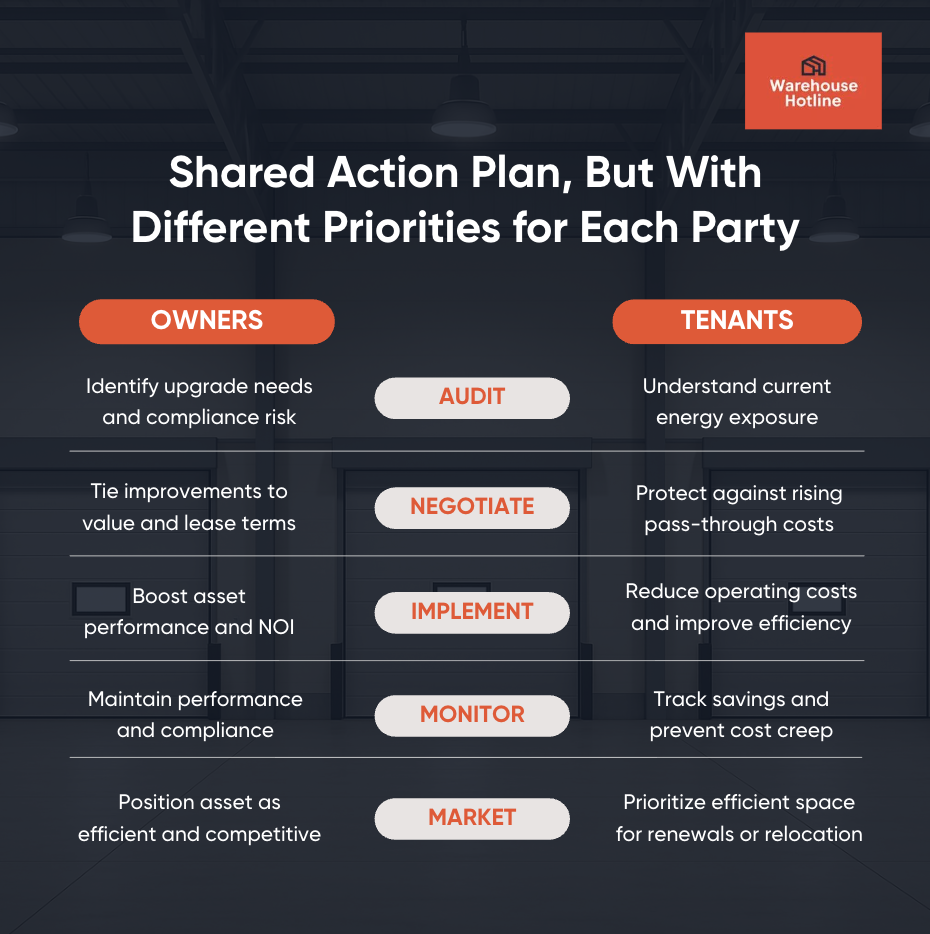
- Audit: Benchmark energy usage for lighting, HVAC, refrigeration, dock doors, and building envelope.
- Negotiate: Use audit data to drive co-investment in upgrades, utility pass-through protection, or CAM caps in leases.
- Implement: Prioritize fast-payback improvements — LEDs, lighting controls, insulation, dock seals, efficient HVAC.
- Monitor: Add submeters and an EMS to systematically manage ongoing energy use and avoid surprises.
- Market / Explore Alternatives: When leasing or renewing, highlight energy efficiency — or evaluate modern warehouses with built-in efficiency and BPS compliance.
According to Aviva Sonenreich, energy strategy is becoming essential. With potential rate increases ahead and Colorado accelerating toward performance-standard compliance, tenants and owners must integrate energy planning into leases, underwriting, and long-term asset strategy. Those who act early strengthen NOI, competitiveness, and asset durability. Those who delay risk margin erosion if rates rise or compliance tightens over time.
Act Now: Implement audits, targeted retrofits, and smart lease structures to control Colorado warehouse energy costs before the 2026 increases take effect.
Next Steps for Warehouse Owners & Tenants:
- Connect with a CRE advisor familiar with BPS compliance to benchmark assets, model upgrade payback, and future-proof your income stream.
- Schedule a full energy audit this quarter to gain actionable insights.
- Leverage audit results in your next lease negotiation to protect margins and optimize occupancy costs.
Want benchmarking support or help structuring energy-aligned leases? The Warehouse Hotline can assist, whether you’re operating, renewing, or acquiring space.
Q1: Do all warehouses in Colorado have to comply with BPS?
A1: No. Many may be exempt if more than 50% of the floor area qualifies as industrial, manufacturing, or storage use.
Q2: How much will electricity costs increase in 2026?
A2: Xcel Energy has filed a proposal that would raise residential bills by roughly 9.9% and large commercial/industrial bills by 7–9% if approved. Actual increases will vary by utility, customer class, and regulatory decisions.
Q3: What retrofits provide the highest ROI?
A3: LED lighting, HVAC optimization, insulation, controls, and dock system upgrades.
Q4: How can tenants protect themselves?
A4: Negotiate CAM caps, co-funded upgrades, and audit rights.
Q5: Where do I start?
A5: Begin with a comprehensive energy audit to benchmark current usage and plan improvements.
Follow Aviva and The Warehouse Hotline for exclusive insights, expert tips, and behind-the-scenes content on
- Website: The Warehouse Hotline
- TikTok: @avivarealestate
- X (Twitter): Aviva – Denver – Warehouse
- Facebook: Aviva Sonenreich’s Denver Commercial Real Estate | Warehouse Hotline
- LinkedIn: Aviva Sonenreich | Warehouse Hotline
- CRE Secrets: Spotify | Apple