
Denver warehouse financing is becoming more challenging in 2025. With high interest rates and tighter lending standards, securing capital for warehouse acquisitions requires a well-prepared strategy. Investors who understand hidden costs, lender requirements, and financing options can still close successful deals in Denver’s competitive industrial market.
High Interest Rates and Tougher Lending
The Federal Reserve’s higher interest rates have pushed up borrowing costs across commercial real estate. In Denver, this means warehouse investors face stricter approval standards. Lenders now scrutinize occupancy levels, tenant credit quality, and property income stability more than ever.
If you’re wondering, “Can I get Denver warehouse financing, and at what cost?” the answer is yes, but only well-prepared investors succeed in this environment.
Positioning Your Investment to Qualify
Boost your financing approval chances with these strategies:
- Occupancy Matters: Lenders favor warehouses with high occupancy and long-term leases.
- Leverage Tenant Credit: Strong tenants reassure lenders about repayment.
- Buy vs Lease: Leasing reduces upfront costs, but buying delivers long-term control and returns if structured properly.
- Work with Local Experts: Brokers and lenders who know Denver’s industrial market smooth the financing process.
Hidden Costs & Important Considerations
Beyond the purchase price, investors must budget for factors that directly impact Denver warehouse financing approval and deal returns:
- Building & Fire Code Retrofits: Denver’s 2025 building and fire code updates (life safety, energy, seismic) can trigger major upgrades for older warehouses, especially pre-2000 assets.
- Environmental Studies: A Phase I ESA typically costs $2,000–$5,000. Skipping it risks six-figure cleanup liabilities.
- Tenant Improvements & Maintenance: Fit-outs (racking, lighting, offices) and deferred maintenance can add 10–20% in costs.
- Soft Costs: Lender fees, permits, inspections, insurance, and legal reviews can materially raise acquisition budgets.
Proactive due diligence helps investors avoid financing delays and unexpected overruns.
Mini Case Study: How an Investor Secured Financing in Commerce City
The Warehouse Hotline assisted an investor in 2024 on what was initially expected to be a warehouse lease. However, the deal quickly evolved into a full purchase opportunity. Despite rate pressures and stricter lending, the property’s strong occupancy and tenant stability allowed for favorable loan terms
The warehouse’s heavy industrial zoning, secure fencing, and prime highway access made it a highly financeable asset in Denver’s market. By focusing on lease strength and cash flow, The Warehouse Hotline guided the buyer through a smooth transition from lease intent to purchase, ultimately securing successful Denver warehouse financing.
Navigating Denver Market Headwinds
Denver’s industrial vacancy rate rose from roughly 4% in 2023 to 7–8% in 2025, reflecting more available warehouse space but steady demand. Lenders responded with tighter credit, placing emphasis on tenant reliability and consistent cash flow.
The Warehouse Hotline secured financing by presenting strong lease agreements, validated tenant credit, and detailed financial projections—key to winning approval in today’s environment.
Financing Options and Strategies
Investors exploring Denver warehouse financing have multiple paths:
- Traditional Bank Loans: Require 25–50% down, with loan-to-value (LTV) ratios typically 50–75%.
- Alternative Lenders: Faster funding but higher rates (8–15%).
- SBA Loans: Competitive for qualifying businesses, though criteria are strict.
- Private Investors: Flexible and negotiable terms for unique borrower needs.
Selecting the right option depends on credit profile, project scope, and timeline.
Here’s how the most common financing sources compare:
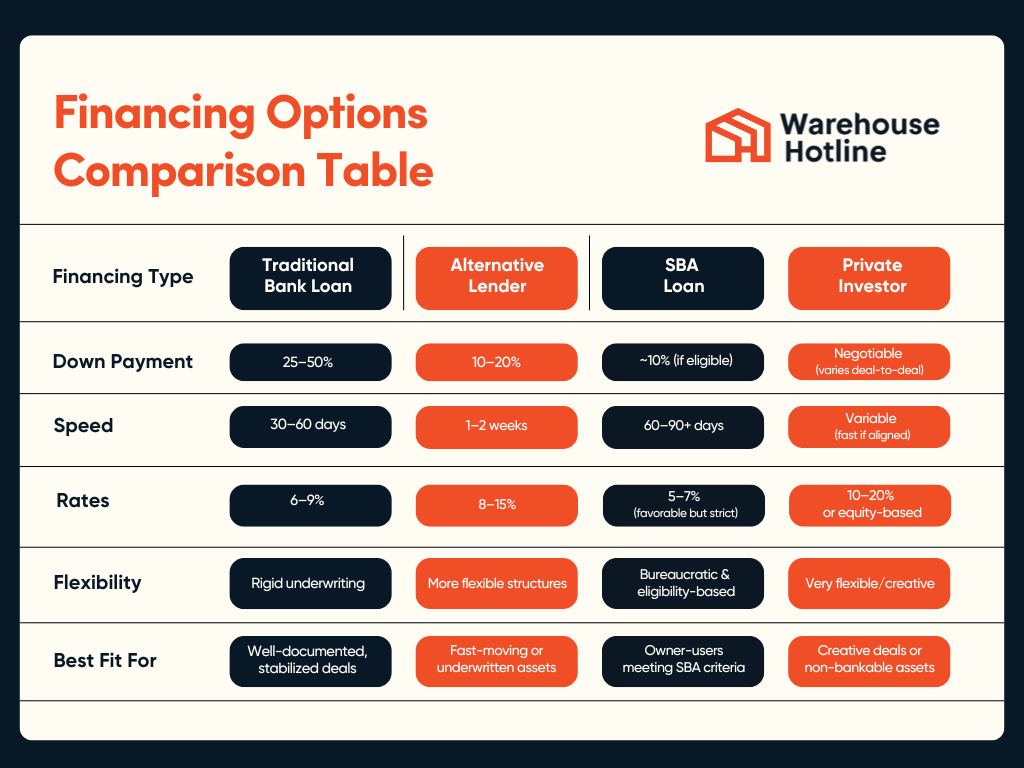
Choosing the right route depends on your credit profile, project size, and urgency. In today’s market, deals are still getting done—but lenders are scrutinizing documentation, tenant strength, and projected cash flow more closely than ever.
What Should Investors Do Now?
- Secure long-term leases with stable tenants.
- Build lender relationships early.
- Compare buy vs lease financially.
- Budget for code compliance, environmental, and soft costs upfront.
- Partner with brokers experienced in Denver warehouse financing.
Next Step: Contact The Warehouse Hotline for tailored advice on your financing strategy.
Q1: Can I still get Denver warehouse financing in 2025?
A1: Yes, but lenders are stricter. Strong tenants and stable leases improve approval odds.
Q2: What hidden costs should I plan for?
A2: Building retrofits, environmental studies, tenant improvements, and permits can add 10–20%+ to costs.
Q3: What are the best financing options?
A3: Traditional loans, SBA programs, alternative lenders, and private investors.
Q4: How can I improve loan approval chances?
A4: Emphasize tenant credit, long leases, and reliable cash flow.
Q5: Should I lease or buy a warehouse?
A5: Leasing cuts upfront costs; buying builds long-term control and equity.
Follow Aviva and The Warehouse Hotline for exclusive insights, expert tips, and behind-the-scenes content on
- Website: The Warehouse Hotline
- TikTok: @avivarealestate
- Instagram: @avivarealestate
- X (Twitter): Aviva – Denver – Warehouse
- Facebook: Aviva Sonenreich’s Denver Commercial Real Estate | Warehouse Hotline
- LinkedIn: Aviva Sonenreich | Warehouse Hotline
- CRE Secrets: Spotify | Apple | Website
Need insights on Denver’s warehouse market or guidance on your next move? Connect with The Warehouse Hotline — we’re here to help you find the right fit.
Sources:
- The Warehouse Hotline | Hidden Warehouse Purchase Costs in 2025
- ROI Metal Buildings | How to Finance a Warehouse Successfully
- Cushman & Wakefield | Denver Industrial Marketbeat Q2 2025
- CBRE | Denver Industrial Figures Q2 2025
- Select Commercial | Denver Commercial Mortgage Rates 2025
- CommLoan | Commercial Mortgage Rates
- NerdWallet | Commercial Real Estate Loan Rates 2025
- Denver Building & Fire Codes | Adoption Process 2025