

Executive Summary
Industrial property taxes in Denver are based on assessed values and local mill levies, with changes typically occurring during periodic reassessment cycles rather than increasing steadily year over year.
For warehouse tenants, property taxes are a key component of total occupancy cost—especially in triple net (NNN) leases where taxes are passed through as operating expenses.
Based on our review of industrial assets across Commerce City, Aurora, and Denver, tax patterns often show periods of stability followed by step-changes, which can significantly impact lease economics and underwriting assumptions.
What Are Industrial Property Taxes in Denver?
Answer: Industrial property taxes in Denver are calculated by applying local mill levies to a property’s assessed value and are typically treated as operating expenses in NNN leases.
Property taxes are determined by:
- Assessed property value
- Mill levies set by local taxing authorities
- Property classification and jurisdiction
For industrial properties, these taxes are commonly passed through to tenants, making them a critical factor in evaluating total lease cost.
Why Industrial Property Taxes in Denver Matter for Tenants
Answer: Industrial property taxes directly affect total occupancy cost and can change significantly due to reassessment cycles, impacting lease affordability over time.
For tenants, property taxes:
- Are often reimbursed in NNN lease structures
- Contribute to total cost per square foot
- May increase in step-changes rather than gradually
Because taxes are tied to assessed values, changes in valuation can materially impact operating expenses. This makes it essential to evaluate taxes alongside rent when comparing properties.
Solution: How Tenants Should Approach Industrial Property Taxes in Denver
Answer: Tenants should analyze property taxes as part of total occupancy cost, including lease structure, historical trends, and potential reassessment impacts.
1. Identify Lease Structure
- Confirm whether the lease is NNN, gross, or modified gross
- Understand how taxes are allocated between landlord and tenant
2. Review Historical Tax Data
- Analyze past tax levels for context
- Identify patterns of stability or step-changes
- Compare assessed values where available
3. Incorporate Taxes into Total Cost
- Combine base rent with operating expenses
- Calculate total cost per square foot
- Compare across multiple properties
4. Account for Reassessment Cycles
- Financial projections should include potential variability
- Property taxes are updated periodically, not linearly
- Future tax obligations may change based on reassessments
What Do Real-World Property Tax Patterns Look Like?
Answer: Industrial property taxes often follow a pattern of gradual increases combined with periodic step-changes that reset the tax baseline.
6066 E 49th Ave (Commerce City, CO)
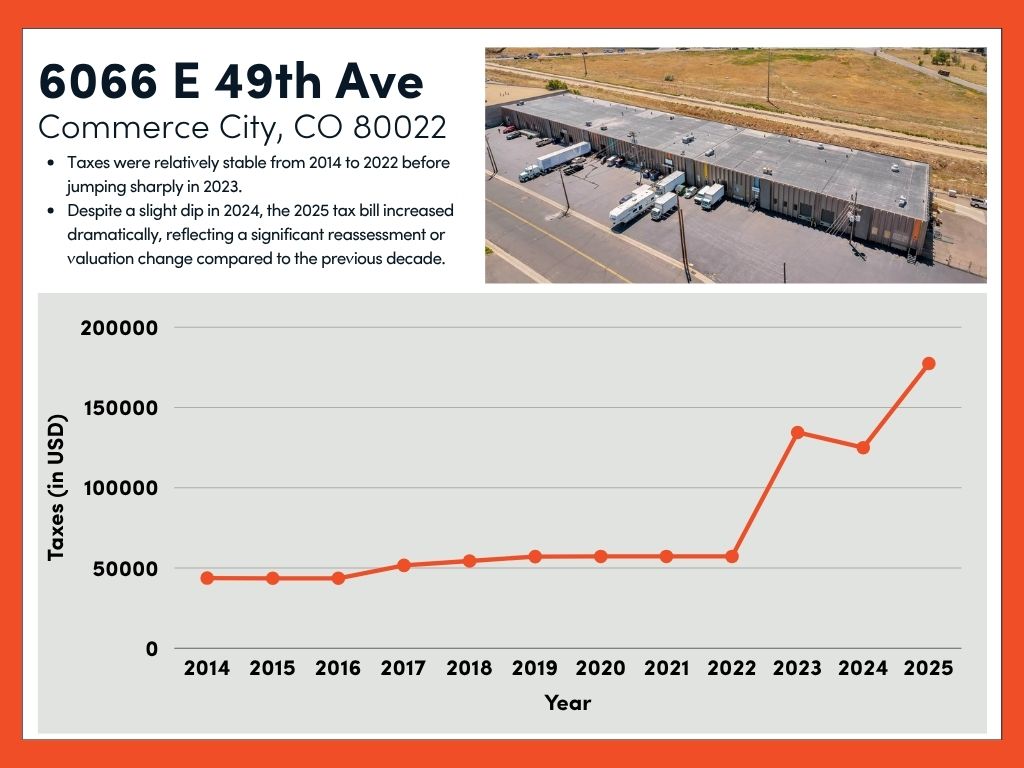
Industrial property taxes in this sample remained relatively stable from 2014 through 2022. A significant increase occurred in 2023, followed by a slight decrease in 2024 and a subsequent increase in 2025.
What this means:
- A long period of stability does not guarantee future consistency
- Reassessments can create a rapid step-change in the tax basis
- Prior operating expenses may not reflect future occupancy costs
- Underwriting assumptions may need to be reset following reassessment events
3596 N Moline St (Aurora, CO)
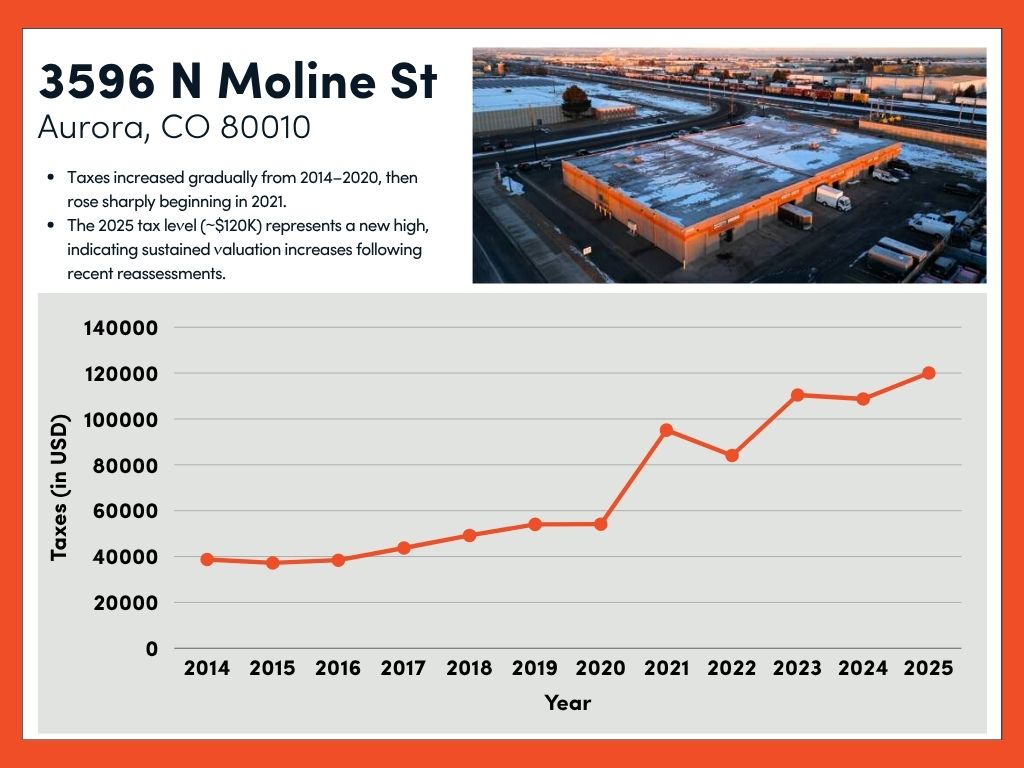
Industrial property taxes increased gradually from 2014 through 2020, followed by a clear step-change beginning in 2021. By 2025, taxes reached approximately $120,000, establishing a new baseline for the property.
What this means:
- Gradual increases can transition into step-changes driven by reassessments
- Tax levels may reset to a higher long-term baseline
- Tenants may experience rising NNN expenses across lease terms
- Long-term projections should account for both gradual growth and resets
3795 Paris St (Denver, CO)
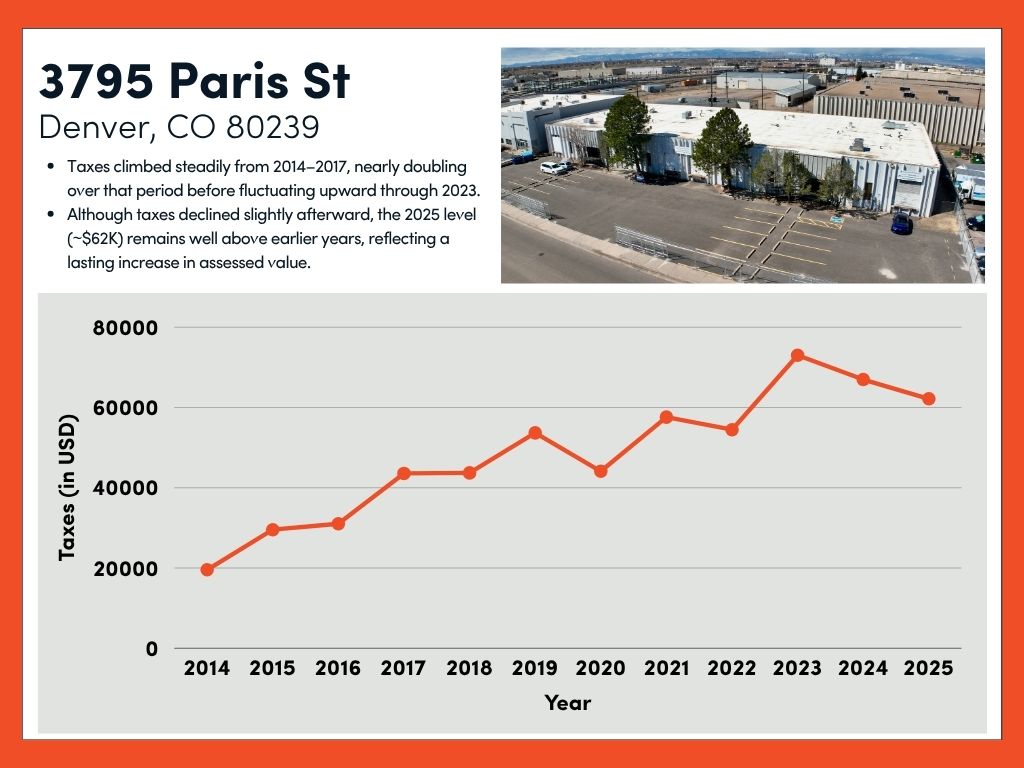
Industrial property taxes increased steadily from 2014 through 2017, nearly doubling over that period, followed by continued upward movement through 2023. While there are fluctuations, the 2025 level (~$62,000) remains elevated relative to earlier years.
What this means:
- Early increases can establish a higher long-term tax baseline
- Even with short-term declines, tax levels may remain elevated
- Historical averages may understate current cost structure
- Sustained increases can impact long-term property performance
Observed Industrial Property Tax Trends Across Select Denver Industrial Properties
| PROPERTY | LOCATION | TREND | KEY INSIGHT |
| 6066 E 49th Ave | Commerce City | Stable → Sharp increase → Adjustment | Reassessments can create sudden cost changes |
| 3596 N Moline St | Aurora | Gradual → Step-change | Taxes can reset to a higher long-term baseline |
| 3795 Paris St | Denver | Steady increase | Early growth can establish long-term cost structure |
Key Observation
Across this sample, industrial property taxes reflect a combination of gradual increases and periodic step-changes driven by reassessments.
Property taxes don’t just increase — they reset to new baselines.
How This Affects Leasing and Underwriting:
- Property taxes should be evaluated as part of total occupancy cost
- Historical stability does not guarantee future consistency
- Reassessment timing can significantly impact cost structure
- Both tenants and owners benefit from underwriting tax variability
These observations are based on a limited set of properties and are not intended to represent all industrial assets in the Denver market. However, they highlight how property tax behavior can influence real-world leasing and underwriting decisions.
How Do Property Taxes Impact Leasing and Underwriting?
Answer: Property taxes influence total occupancy cost, financial modeling, and long-term lease decisions for both tenants and owners.
Key implications include:
- Historical stability does not guarantee future consistency
- Reassessment timing can significantly impact costs
- Tax increases may affect lease affordability
- Both tenants and landlords must account for variability in underwriting
While these observations are based on a limited sample, they reflect common patterns seen in industrial leasing decisions.
What Should Tenants Understand About Industrial Property Taxes?
Answer: Tenants should view property taxes as a dynamic cost component influenced by valuation changes and lease structure.
Key considerations:
- Property taxes are based on assessed value
- Reassessments drive periodic changes
- Taxes are commonly passed through in NNN leases
- Total occupancy cost should include taxes
- Historical data provides context, not certainty
How Can Warehouse Tenants Prepare for Property Tax Changes?
Answer: Tenants can reduce risk by evaluating taxes early, comparing properties thoroughly, and aligning lease structure with financial goals.
- Begin the leasing process early relative to lease expiration
- Request detailed operating expense estimates, including industrial property taxes in Denver
- Evaluate total occupancy cost across multiple properties
- Review lease structures to understand how industrial property taxes in Denver are allocated
- Compare properties using cost per square foot, including taxes
- Consider working with The Warehouse Hotline for Tenant representation to analyze lease options and structure
In our experience, incorporating industrial property taxes into early-stage analysis improves clarity and supports more informed leasing decisions.
How Tenant Representation Helps Navigate Property Taxes
Answer: Tenant representation helps translate property tax data into actionable leasing decisions and financial clarity.
Where Tenant Representation Adds Value
1. Full Occupancy Cost Analysis
Evaluates taxes alongside rent, CAM, and insurance for accurate comparisons
2. Lease Structuring
Clarifies how taxes are passed through and negotiated
3. Market Benchmarking
Compares tax levels across similar properties
4. Scenario Planning
Accounts for potential reassessment changes over time
At The Warehouse Hotline, the focus is on aligning lease decisions with both operational and financial objectives—not just securing space.
Key Takeaways
- Industrial property taxes in Denver are based on assessed value and mill levies
- Reassessments create non-linear changes in tax levels
- Property taxes are a major component of total occupancy cost
- Historical trends do not guarantee future tax stability
- Lease structure determines how taxes impact tenants
- Comparing total cost across properties leads to better decisions
- Early analysis improves lease outcomes and financial clarity
Conclusion
Industrial property taxes are a critical but often overlooked component of warehouse leasing in Denver. Because tax levels can change significantly during reassessment cycles, tenants should evaluate them early and incorporate them into total occupancy cost analysis.
The most effective leasing strategies account for both current costs and future variability—ensuring decisions support long-term operational and financial goals.
Q1: What are industrial property taxes in Denver based on?
A1: They are based on assessed property values multiplied by local mill levies.
Q2: How often do industrial property taxes change?
A2: Taxes typically change during periodic reassessments rather than increasing gradually each year.
Q3: Are property taxes included in warehouse leases?
A3: In NNN leases, property taxes are usually passed through to tenants as operating expenses.
Q4: Why do property taxes sometimes increase significantly?
A4: Significant increases are often tied to reassessments that adjust property values.
Q5: Should tenants include property taxes when comparing leases?
A5: Yes. Property taxes are a key part of total occupancy cost and should always be considered.
Q6: Can historical tax data predict future costs?
A6: Historical data provides context, but future taxes may change due to reassessments and updated valuations.
Follow Aviva and The Warehouse Hotline for exclusive insights, expert tips, and behind-the-scenes content on
- Website: The Warehouse Hotline
- Youtube: Aviva Real Estate
- TikTok: @avivarealestate
- X (Twitter): Aviva – Denver – Warehouse
- Facebook: Aviva Sonenreich’s Denver Commercial Real Estate | Warehouse Hotline
- LinkedIn: Aviva Sonenreich | Warehouse Hotline
- CRE Secrets: Spotify | Apple