
Investors Are Reassessing Risk in 2025
Over the last decade, industrial real estate trends in 2025 show the sector’s transformation from the overlooked “butt end” of commercial property types to the “bell of the ball.” But the latest industrial real estate trends 2025 reveal new challenges on the horizon. While rents have skyrocketed from $4 to $13+ per square foot in major markets, many investors now face unexpected tax hikes and rising debt risks.
As heard on the CRE Secrets podcast,The Episode Every Industrial Real Estate Investor Needs to Hear…, hosted by Aviva Sonenreich.
Joel Friedland, a seasoned syndicator with over 100 deals and thousands of leases under his belt, explains that property taxes—sometimes doubling overnight—and compressed cap rates are squeezing returns tighter than ever. The problem? Many investors are still using outdated playbooks, risking over-leverage and costly hidden pitfalls in today’s complex industrial real estate trends 2025 landscape.
And the biggest challenge?
Returns have compressed dramatically.
“In 1989, if we couldn’t get 10%, we didn’t do the deal. Now, people syndicate at 6% and call it normal.” — Joel Friedland
Today’s syndicators face rising acquisition costs, increased competition, and a flood of investors chasing passive income without fully understanding the risks behind those flashy pro formas. Add zoning surprises, limited truck access, and hidden tax liabilities, and you’ll find the margin for error razor-thin — exactly why understanding industrial real estate trends 2025 matters more than ever.
The Strategy Behind Low-Debt Industrial Syndication
Joel’s solution wasn’t financial engineering—it was radical discipline built around the realities of industrial real estate trends 2025.
After surviving the 2008 crash with 50 debt-laden properties, Joel swore off heavy leverage. His approach now:
✅ 70 active investors
✅ Max 30% LTV—or no debt at all
✅ Focus on boring but versatile multi-tenant warehouses
✅ Buy for cash flow, not speculation—essential in the context of current industrial real estate trends 2025
“We don’t do cash calls. We don’t gamble. We buy right and plan for worst-case scenarios.”
Joel also runs every deal through a brutal due diligence gauntlet:
- Real estate taxes (current and post-purchase)
- Zoning and use restrictions
- Dock turning radii
- Sprinkler system density limits
- Ceiling height stacking regulations
“You miss one loading dock layout, and a 40,000 SF building becomes worthless in today’s industrial real estate trends 2025 environment.”
Why This Strategy Wins — Even in a Crowded 2025 Market
Joel’s conviction isn’t theory—it’s built from 100+ syndicated deals, 5,000+ industrial leases, and boots-on-the-ground knowledge shaped by industrial real estate trends 2025.
Real example: A building near Toronto just re-leased at $9/sq ft net — up from $5 five years ago. That’s an 80% rent increase in one lease cycle. But as Joel warns, those returns only matter if you buy right and understand every input — especially taxes.
“We had a deal this year where the taxes were projected to hit $11.85/sq ft. That’s almost double the rent. That deal’s off the table.”
His approach mirrors that of generational operators like Aviva Sonenreich’s family, who’ve held Denver warehouses since 1984 using similar low-leverage, high-discipline strategies.
This is the stuff you won’t find in cookie-cutter real estate courses.
Your Industrial Real Estate Survival Playbook for 2025
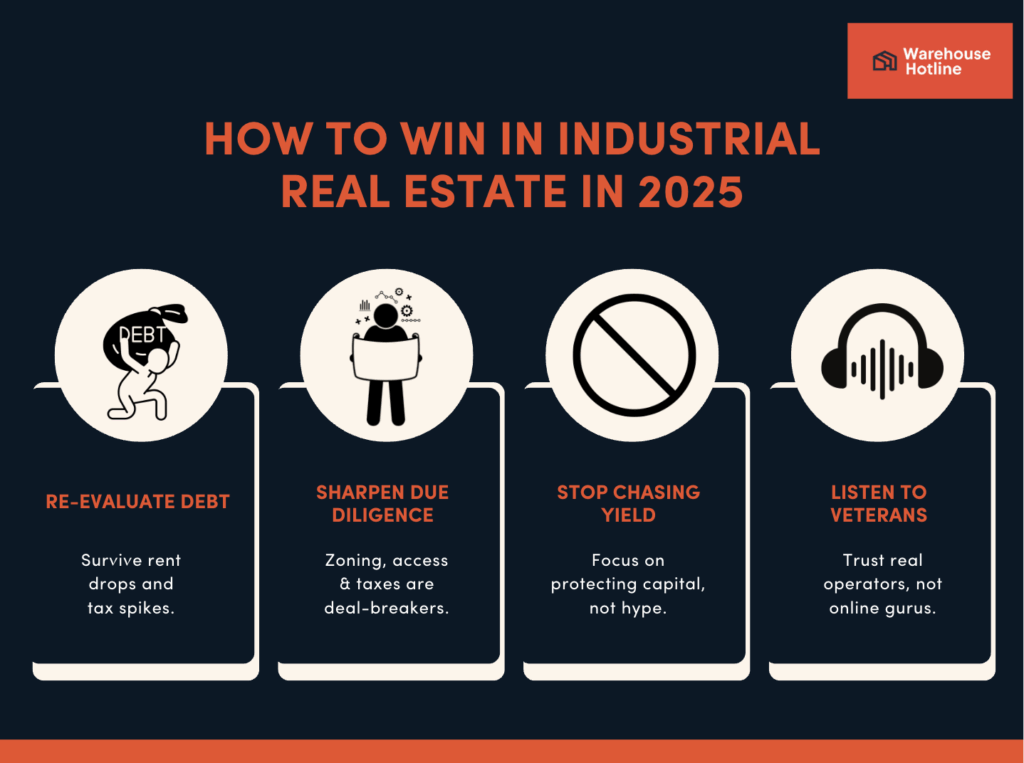
🎧 Listen to the CRE Secrets podcast now, The Episode Every Industrial Real Estate Investor Needs to Hear…, Discover how Clint Harris transforms vacant big box stores into cash-flowing self-storage investments. This episode is packed with actionable strategies to help you think bigger, invest smarter, and unlock new opportunities in industrial real estate.
Q1: Why is industrial real estate booming?
A1: High demand, fast construction, and diverse tenants make industrial the top CRE sector today.
Q2: How should investors handle debt?
A2: Use low or no debt strategies to survive rent drops and tax increases.
Q3: What due diligence matters most?
A3: Check zoning, access, ceiling height, sprinklers, and taxes to avoid costly errors.
Q4: Are returns still strong?
A4: Yields are lower (6-7%), so focus on protecting capital over chasing high returns.
Q5: How do experts like Joel invest?
A5: Conservative underwriting, thorough diligence, and low leverage help manage risk.
Get Your Industrial Real Estate Edge — Connect with Aviva & The Warehouse Hotline
👉 Follow Aviva and The Warehouse Hotline for exclusive insights, expert tips, and behind-the-scenes content on:
- Website: The Warehouse Hotline
- TikTok: @avivarealestate
- Instagram: @avivarealestate
- X (Twitter): Aviva – Denver – Warehouse
- Facebook: Aviva Sonenreich’s Denver Commercial Real Estate | Warehouse Hotline
- LinkedIn: Aviva Sonenreich | Warehouse Hotline
Have questions or ready to grow your CRE marketing? Reach out anytime — Aviva’s here to help you succeed.