Executive Summary
Warehouse lease renewals are no longer automatic in 2026 because tenants are actively evaluating market pricing, operational efficiency, and alternative warehouse options before making renewal decisions.
This shift is also increasing demand for tenant representation Denver earlier in the leasing cycle.
In Denver’s industrial market, tenants are shifting from passive renewals to structured decision-making processes. This makes tenant representation Denver increasingly important earlier in the leasing cycle, not just at expiration.
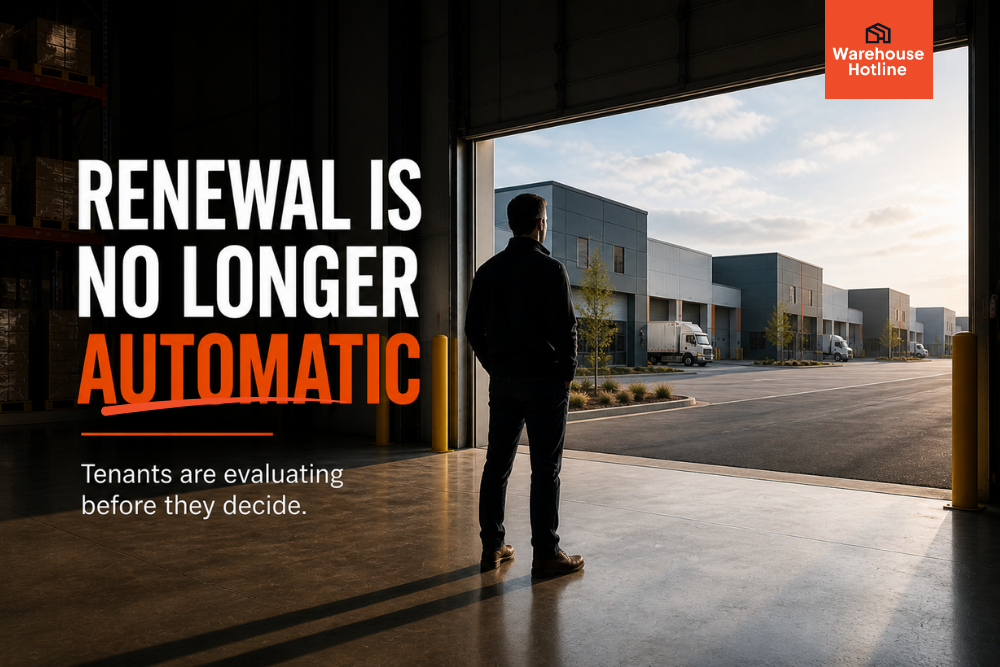
Renewal is no longer assumed—it must be justified through cost, operations, and market comparison.
WHY ARE WAREHOUSE LEASE RENEWALS NO LONGER AUTOMATIC?
Warehouse lease renewals are no longer automatic in 2026 because tenants are benchmarking market conditions, evaluating operational fit, and comparing alternative warehouse options before committing to renewal.
Historically, warehouse tenants would renew leases if the space functioned operationally. That assumption no longer holds.
In today’s Denver industrial market, tenants are more financially aware and data-driven. They are actively reviewing:
- whether current rent matches market conditions
- whether the space is operationally efficient
- whether better alternatives exist nearby
This shift is driven by increased transparency in industrial leasing data and stronger internal cost-control pressure across occupiers.
In practice, tenants are beginning lease evaluations 12–24 months before expiration, even when renewal is the expected outcome.
Common behaviors include:
- benchmarking current rent against competing listings
- identifying inefficiencies in warehouse layout or logistics flow
- testing landlord flexibility earlier in the cycle
- discovering that relocation may offer better long-term efficiency
Renewals are no longer default outcomes. They are structured financial decisions that require justification before execution.
WHAT CHANGED IN WAREHOUSE LEASING BEHAVIOR?
Warehouse leasing behavior has shifted from passive renewal decisions to active evaluation of cost, operations, and market alternatives.
Tenants now treat lease renewal as part of a broader financial strategy rather than an administrative process. This includes analyzing total occupancy cost, not just base rent.
Key factors influencing this shift:
- increased visibility into market rents
- more available industrial inventory in key submarkets
- stronger focus on logistics efficiency
- internal pressure to reduce occupancy costs
Occupancy Cost: The total cost of leasing warehouse space, including base rent, CAM charges, NNN expenses, and annual escalations.
This creates a more competitive renewal environment where tenants have leverage—but only if they evaluate early.
This shift is directly increasing reliance on tenant representation Denver to benchmark options and evaluate lease decisions.
HOW DO TENANTS EVALUATE WAREHOUSE LEASE RENEWALS IN 2026?
Tenants evaluate warehouse lease renewals using three key factors: financial benchmarking, operational fit, and market alternatives.
Financial Benchmarking (Cost Layer)
Tenants compare:
- market rent for similar warehouse space
- CAM and NNN charges
- escalation structures
- concessions available in competing deals
Operational Fit (Usage Layer)
Tenants evaluate whether the current space supports:
- logistics flow efficiency
- labor accessibility
- loading and dock configuration
- space utilization efficiency
Market Optionality (Leverage Layer)
Even if relocation is not the goal, tenants:
- review competing warehouse listings
- model relocation costs
- assess submarket differences
- test landlord willingness to negotiate
Renewals now function as full lease negotiations, not extensions.
WHAT WE SEE IN THE DENVER INDUSTRIAL MARKET
In Denver, tenants are increasingly initiating lease evaluations 12–24 months before expiration, even when they expect to renew.
This behavior reflects a shift toward proactive lease management rather than reactive decision-making.
Tenants are becoming more aware that:
- small differences in rent compound over time
- operational inefficiencies impact long-term cost
- alternative warehouse options may offer better layouts or pricing
Market Signal
We consistently see:
- tenants discovering above-market effective rent
- relocation scenarios improving operational efficiency
- landlords offering more flexibility when competition is introduced
- deals becoming more negotiation-driven earlier in the process
Early evaluation is now the primary driver of leverage in warehouse lease decisions.
WHAT SHOULD WAREHOUSE TENANTS DO NEXT?
Warehouse tenants should begin lease evaluation early, benchmark market conditions, and model relocation scenarios before entering renewal negotiations.
Action Steps
- Start evaluation 12–24 months before expiration
- Benchmark current lease vs market conditions
- Analyze total occupancy cost (not just rent)
- Evaluate operational efficiency of current space
- Run relocation scenarios for leverage
Tenants who evaluate early consistently achieve better lease outcomes than those who wait until expiration pressure builds.
Q1: Why are warehouse lease renewals no longer automatic?
A1: Warehouse lease renewals are no longer automatic because tenants now actively evaluate market conditions, operational efficiency, and alternative warehouse options before making decisions.
Q2: What is tenant representation in Denver?
A2: Tenant representation Denver refers to advisory services that help warehouse tenants evaluate lease options, compare market alternatives, and negotiate lease terms based on financial and operational goals.
Q3: When should tenants start evaluating lease renewals?
A4: Tenants should begin evaluating renewals 12–24 months before lease expiration to maximize leverage and decision flexibility.
Q4: What is the biggest factor in warehouse lease decisions today?
A4: The biggest factor is total occupancy cost, including rent, CAM charges, and NNN expenses—not just base rent.
Q5: Why is early lease evaluation important?
A5: Early evaluation increases leverage, improves negotiation outcomes, and prevents rushed decision-making under expiration pressure.
Final insight
Warehouse lease renewals in 2026 are no longer automatic—they are structured financial and operational decisions shaped by market transparency, cost awareness, and tenant strategy.
For tenants in Denver’s industrial market, this represents a fundamental shift:
Renewal is no longer assumed. It is earned through evaluation.
And in this environment, tenant representation Denver becomes a critical factor in ensuring decisions are based on data, not default assumptions.
In this environment, tenant representation Denver plays a critical role in turning renewal decisions into structured, data-driven outcomes.
Follow Aviva and The Warehouse Hotline for exclusive insights, expert tips, and behind-the-scenes content on
- Website: The Warehouse Hotline
- Youtube: Aviva Real Estate
- TikTok: @avivarealestate
- X (Twitter): Aviva – Denver – Warehouse
- Facebook: Aviva Sonenreich’s Denver Commercial Real Estate | Warehouse Hotline
- LinkedIn: Aviva Sonenreich | Warehouse Hotline
- CRE Secrets: Spotify | Apple