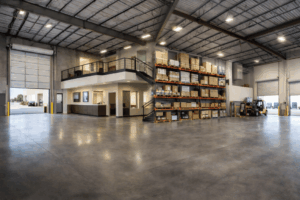

Problem: Why 2026 Will Be a Pivotal Year for Warehouse Tenants
Warehouse lease negotiation will be critical for tenants in 2026 as Denver’s industrial market enters a new phase. After years of rapid rent growth and limited supply, industry reports suggest 2025 could mark a stabilization period. The clauses negotiated in 2025 will directly impact warehouse costs for tenants renewing leases in 2026.
Many tenants who signed leases in 2021–2022 are now approaching renewal, only to find that their agreements no longer reflect current market conditions. Without careful negotiation, tenants risk facing significant unanticipated costs if key lease clauses are outdated or unclear.
In 2026, we expect:
- Landlords tightening concessions as vacancy normalizes.
- Operating expenses are expected to rise further, with some submarkets already reporting double-digit increases in insurance and property taxes based on Q3 2025 market data.
- Renewal clauses rolling over at outdated escalation rates. Many leases signed in 2021–2022 may include escalation terms that no longer reflect current market rates.
The real danger isn’t just overpaying rent—it’s signing inflexible agreements that quietly shift cost and risk onto tenants. Here’s where most tenants lose leverage in warehouse lease negotiations:
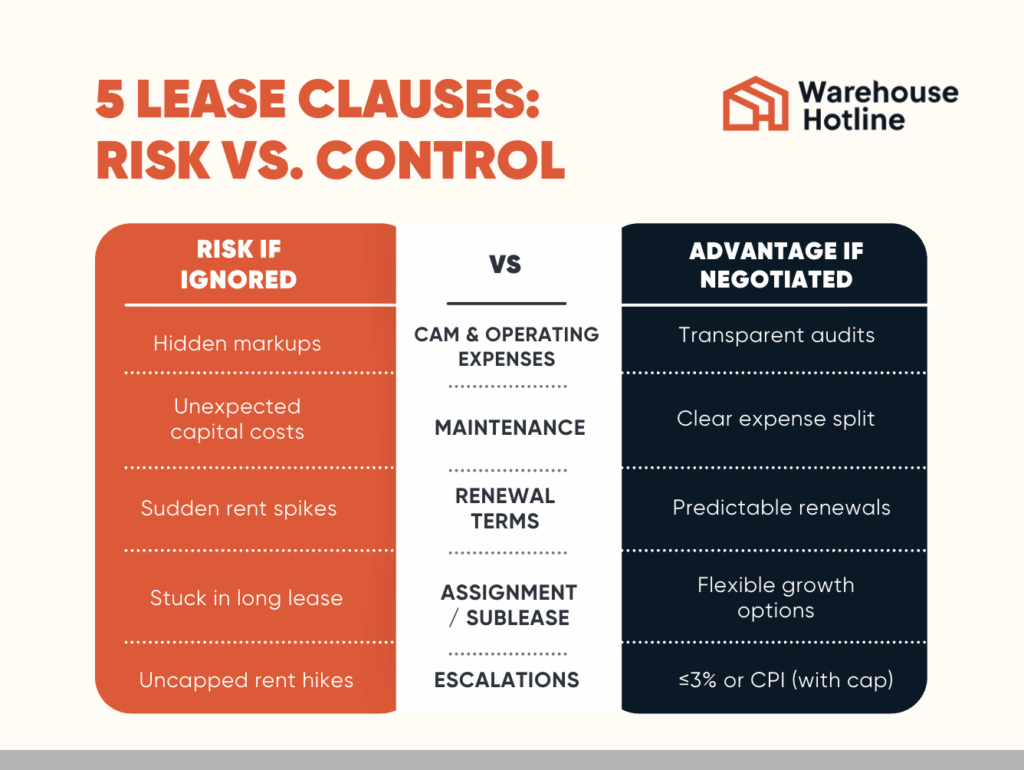
- Triple-net misunderstandings: CAM (Common Area Maintenance) fees often include more than expected—from roof repairs to landscaping.
- Maintenance ambiguity: Tenants may unknowingly assume capital repair obligations that should remain with the owner.
- Renewal options: Missing clear renewal clauses can result in higher rents or even displacement.
- Assignment and subleasing rights: Without negotiation, tenants lose flexibility if they outgrow their space.
- Escalation formulas: Automatic annual rent bumps of 3–5% compound quickly—especially across large industrial footprints.
- Termination penalties: Some leases limit exit flexibility, locking tenants into unfavorable terms during downturns or relocations.
In today’s market, a strong warehouse lease negotiation isn’t just about lowering rent—it’s about gaining clarity, control, and cost predictability before 2026 renewals reset the playing field.
Solution: Build a 2026-Ready Warehouse Lease Negotiation Playbook
Smart tenants see 2025 renewals not as a routine paperwork cycle, but as the launchpad for a stronger, more flexible position in 2026.
At The Warehouse Hotline, we help tenants move beyond “price-first” thinking by focusing on the five clauses that shape real costs, control, and leverage long after the ink dries.
Our 2026-Ready Negotiation Framework helps tenants protect cash flow, flexibility, and operational control:
1. Start Early (9-12 Months Out) Audit Every Clause
Begin preparing now for 2026 renewals. Early movers gain access to better inventory, incentives, and analysts anticipate that concessions may tighten as vacancy rates stabilize.
2. Audit Every Clause
Review maintenance, renewal, and expansion language carefully—especially around structural repairs (roof, HVAC, foundation) and capital expenditures.
Pro Tip: Add a “maintenance carve-out” so the landlord remains responsible for major replacements.
3. Quantify Operating Expenses (CAM & Taxes)
Understand what’s included—and what isn’t. Request a breakdown of historical CAM, tax, and insurance costs to forecast 2026 increases.
Pro Tip: Negotiate a “CAM Audit Right” so you can review charges annually.
4. Negotiate Flexibility (Assignment & Sublease Rights)
Protect your ability to relocate, expand, or sublease without penalty.
Pro Tip: Require that landlord consent “shall not be unreasonably withheld.”
5. Cap Renewal Rates & Escalations
Pre-set renewal terms now for predictability later.
Pro Tip: Ask for rent pegged to “market rate with a 5% cap” or a fixed annual increase of 3% or less to avoid CPI spikes.
These clauses determine the true cost of occupancy—and small adjustments here can reduce total expenses by 5–10% over the lease term.
By treating 2025 as your negotiation runway, you’re not just reacting to the market—you’re setting the terms before the next cycle starts. Tenants who plan ahead for 2026 lock in predictable costs while competitors scramble during renewal season
Proof: Hypothetical Example — How Negotiating Clauses Impacts Total Cost
Let’s say a 40,000 SF warehouse tenant in Montbello signs a 5-year triple-net lease at $10.00 per SF, with $4.50 per SF in CAM and expenses.
At first glance, the deal looks straightforward — but a few unexamined clauses can add up fast:
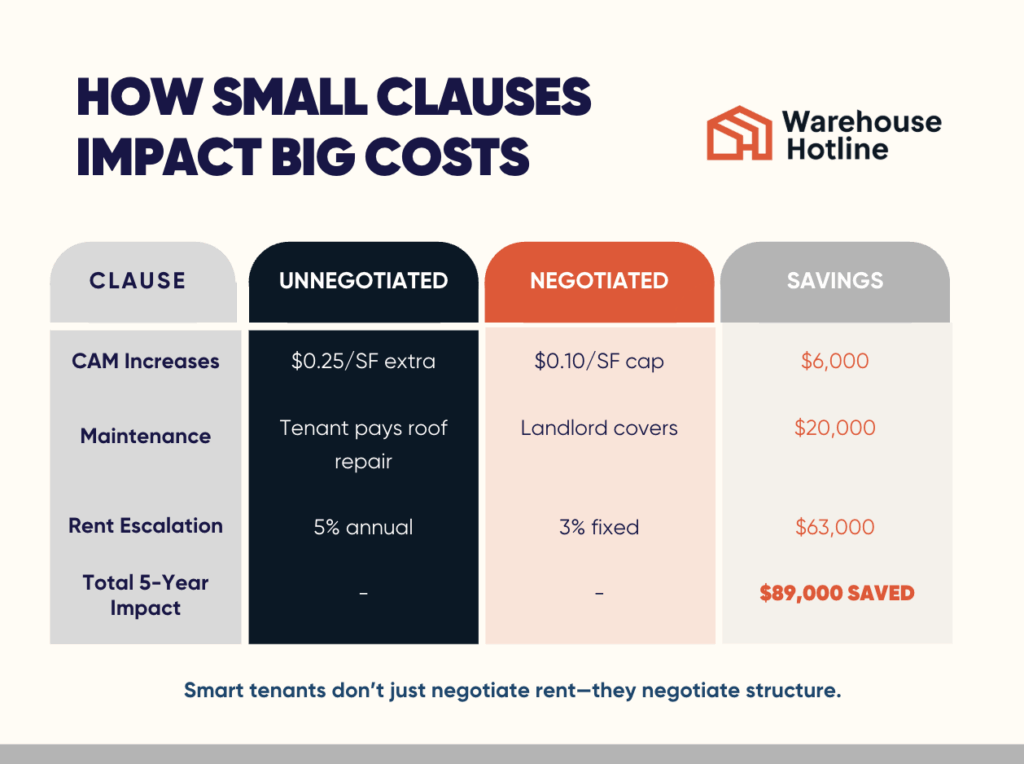
Result: Hypothetically, negotiating just three key clauses could save a tenant tens of thousands over the lease term.
That’s the power of understanding lease structure. Total lease cost is determined not only by the base rent but also by how expenses, escalations, and responsibilities are structured.
Action: Get Ahead of 2026 Warehouse Lease Renewals Now
If your warehouse lease expires in 2026, the best time to act is now. Early preparation allows tenants to identify opportunities to negotiate better rates, flexible terms, and limit exposure to potential cost increases before the next market cycle.
Here’s how to prepare:
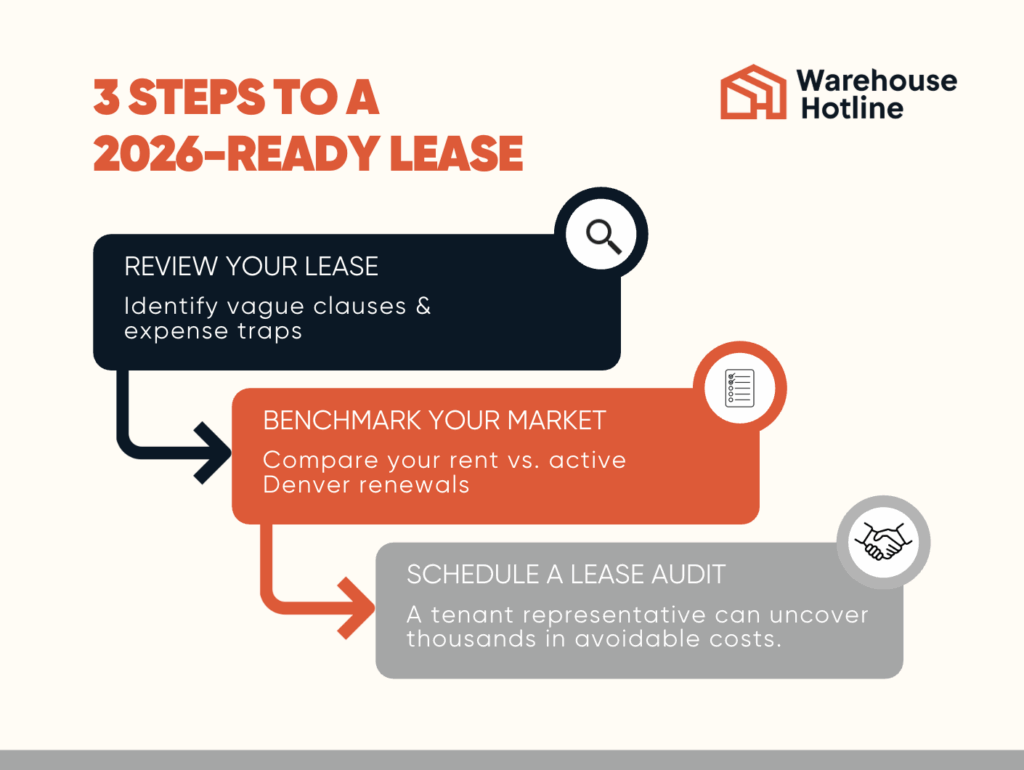
- Review Your Current Lease: Identify clauses tied to expenses, renewals, and repairs. Flag anything vague or open-ended that could lead to unexpected costs.
- Benchmark Your Market: Compare your lease terms to active listings and recent renewals in your submarket—whether in Aurora, Montbello, or Central Denver. Knowing your market average strengthens your negotiation position.
- Schedule a Lease Audit with a Tenant Rep: Before renewing or signing, have an industrial broker review your lease line by line. A short consultation can reveal thousands in avoidable costs and strengthen your 2026 strategy.
At The Warehouse Hotline, our tenant representation team helps businesses translate complex lease language into clear, negotiable terms—so every tenant walks into 2025 with confidence and control, ready for the 2026 market cycle.
Next Step: Schedule Your 2026 Lease Readiness Review
Don’t wait for your renewal notice to arrive.
Contact The Warehouse Hotline today to schedule your 2026 Lease Readiness Review, a one-on-one consultation to identify cost-saving opportunities, renegotiation windows, and strategic options before the next market shift hits.
Start 2026 prepared—with clarity, control, and confidence in every square foot.
Q1: Why should I start negotiating my warehouse lease in 2025 for 2026?
A1: Early negotiation gives tenants leverage before landlords raise rates or reduce concessions in the next cycle.
Q2: What clauses should I focus on when negotiating my warehouse lease?
A2: Focus on five key clauses—CAM and operating expenses, maintenance responsibilities, renewal terms, assignment rights, and rent escalations.
Q3: How do I know if my renewal rate is fair?
A3: Compare your rent with current market averages and request documentation or comps from your landlord to justify increases.
Q4: Can I renegotiate a lease before it expires?
A4: Yes.Many tenants have the opportunity to renegotiate 9–12 months before expiration.
Q5: How can a tenant rep help with lease negotiations?
A5: Tenant reps provide market data, uncover overcharges, and structure clauses that protect your business long-term—saving time, cost, and risk.
Follow Aviva and The Warehouse Hotline for exclusive insights, expert tips, and behind-the-scenes content on
- Website: The Warehouse Hotline
- TikTok: @avivarealestate
- X (Twitter): Aviva – Denver – Warehouse
- Facebook: Aviva Sonenreich’s Denver Commercial Real Estate | Warehouse Hotline
- LinkedIn: Aviva Sonenreich | Warehouse Hotline
- CRE Secrets: Spotify | Apple