The cost to lease industrial space in Denver is rising—and understanding the true numbers matters more than ever in 2025.
Problem: Rising Costs, Shifting Market
For tenants in Denver’s industrial market, the biggest challenge isn’t finding space — it’s understanding what the lease really costs.
Most tenants start with one simple question: “What’s the rent per square foot?”
But that number rarely tells the full story. Base rent is just the tip of the iceberg. Operating expenses, property taxes, CAM charges, and insurance can add 20–30% to the total bill. At the same time, small-bay industrial spaces remain highly competitive, with asking rents swinging dramatically between submarkets — from $6 near DIA to $15 in Central Denver.
The result? Tenants risk overpaying, underbudgeting, or missing out on prime space if they don’t understand the true cost to lease industrial space in Denver.
Solution: Understanding the Cost to Lease Industrial Space in Denver
For tenants, the key is knowing not just the rent but the all-in cost of occupying industrial space. In 2025, here’s what you should expect:
- Average Rent Range: $7–$15 per square foot annually (varies by building type and location).
- Logistics Corridors (near DIA): Lower rates of $6–$8/SF, mostly for larger warehouses.
- Small-Bay / Infill Areas (Montbello, Central Denver): Higher rates of $12–$15/SF, driven by tight supply.
- Operating Costs: Add $4-$6/SF for expenses such as CAM, property taxes, and insurance.
- Vacancy: Currently ~8.7%, the highest in a decade. While this gives tenants leverage, small-bay spaces remain competitive.
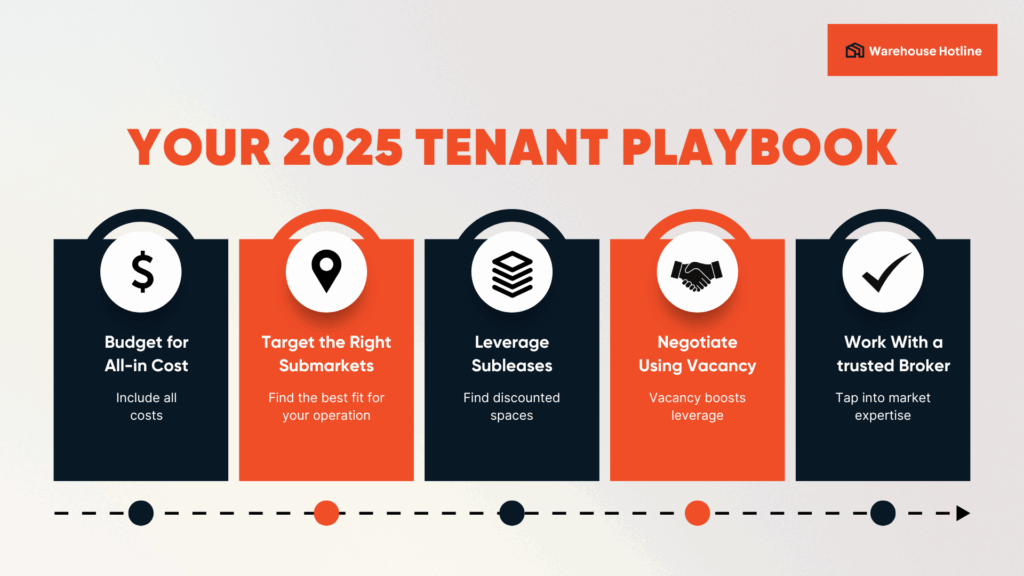
The 2025 Tenant Playbook helps companies budget for the true cost to lease industrial space in Denver — beyond just base rent.
Proof: What the Market Data Shows
Industry data backs up these leasing trends. According to CBRE’s Q2 2025 Denver Industrial Figures, average asking rents are $9.72 per square foot annually, though rates vary widely by submarket and property type. Meanwhile, Matthews Real Estate’s Q1–Q2 2025 report highlights that small-bay infill properties command $12–$15 per square foot, with supply remaining consistently tight in Central Denver.
Vacancy has also shifted. Cushman & Wakefield’s Q2 2025 MarketBeat reported Denver’s industrial vacancy at 7.9%, the highest in a decade, with most availability concentrated in large logistics facilities near DIA. Across reports, consensus places vacancy in the 7.9–8.5% range, reflecting the impact of the 2021–2023 construction wave.
Finally, tenant costs extend beyond rent. Warehouse Hotline’s 2025 market commentary notes that operating expenses commonly add 20–30% to effective lease costs, with property taxes driving much of the increase since 2023, even if the exact breakdown differs across properties.
Market Sales and Investment Activity
- Denver’s industrial market experienced a sharp upswing in sales activity in Q2 2025, with transaction volume reaching $452.2 million — a 73.6% increase year-over-year. This figure reflects all industrial property types, including warehouses, flex, and manufacturing.
- Deals have been driven by private capital and institutional buyers, often targeting smaller properties under 50,000 SF, aligning with tenant demand.
- Average sales prices reached $156 per square foot, slightly lower than peak pricing, reflecting a narrowing gap between buyers and sellers.
Vacancy and Rent Trends
- Vacancy reached 8.7% in Q3 2025, well above the 10-year average of 5.6%.
- Vacancy increases have slowed, suggesting stabilization ahead.
- Rents declined slightly by 0.3% year-over-year, but asking rates remain strong at $12.32 per SF on average. In Central Denver, rates typically range from $12 to $14 per SF, with submarkets near DIA offering more cost-effective options.
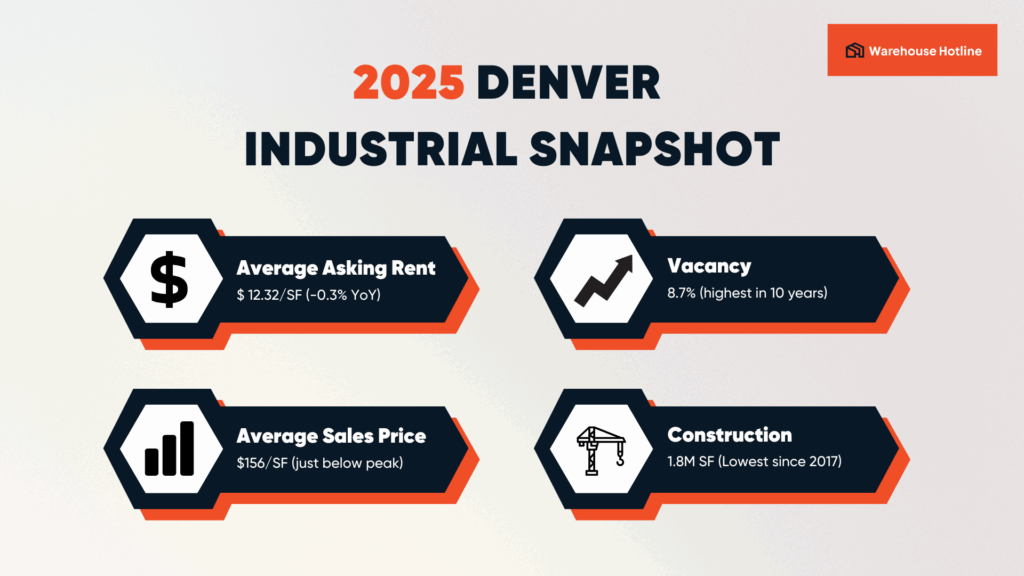
The 2025 Denver Industrial Snapshot shows vacancy, rental averages, and submarket differences shaping tenant costs this year.
Construction Trends Affecting Tenants
- Only 1.8 million SF is under construction in 2025—the lowest since 2017.
- Developers are shifting toward pre-leased or build-to-suit projects rather than speculative builds.
- Smaller, owner-financed developments are emerging, offering tenants more tailored options.
Action: How Tenants Can Protect Themselves in 2025
Tenants who understand the full cost picture and market trends can secure stronger lease terms. Here’s a five-step playbook:
- Budget for All-In Costs
- Always calculate rent plus CAM, insurance, and taxes.
- Example: A $10/SF lease + $3/SF expenses = $13/SF effective rate.
- Target the Right Submarkets
- For lower costs, look to DIA logistics corridors.
- For access and infill, budget more for Central Denver or Montbello.
- Leverage Subleases
- Downsizing activity is creating more sublease opportunities at discounted rates.
- Negotiate Using Vacancy
- With vacancy above 8%, tenants can push for:
- Free rent during build-out
- Tenant improvement (TI) allowances
- Flexible lease terms
- Work With a Broker Who Knows the Market
- Brokers track off-market availabilities and know which landlords are motivated.
By combining these strategies, tenants can reduce the cost to lease industrial space in Denver, avoid hidden charges, and secure space that truly fits their needs.
Q1: What is the average cost to lease industrial space in Denver in 2025?
A1: $7–$15 per SF annually, with averages around $9.72–$12.30/SF depending on report and submarket.
Q2: Why are small-bay spaces more expensive?
A2: Tight supply in infill locations like Central Denver drives rates up to $12–$15/SF.
Q3: What extra costs should tenants budget for?
A3: Add $4-$6/SF for CAM, taxes, and insurance.
Q4: Is now a good time for tenants to negotiate?
A4: Yes. With vacancy near 9%, landlords are offering more concessions.
Q5: How is new construction affecting tenants?
A5: Limited speculative construction means fewer new spaces, but more build-to-suit and pre-leased opportunities.
Follow Aviva and The Warehouse Hotline for exclusive insights, expert tips, and behind-the-scenes content on
- Website: The Warehouse Hotline
- TikTok: @avivarealestate
- Instagram: @avivarealestate
- X (Twitter): Aviva – Denver – Warehouse
- Facebook: Aviva Sonenreich’s Denver Commercial Real Estate | Warehouse Hotline
- LinkedIn: Aviva Sonenreich | Warehouse Hotline
- CRE Secrets: Spotify | Apple | Website
Ready to price your warehouse with confidence? Contact The Warehouse Hotline for a custom valuation today.
If you want clarity on the true cost to lease industrial space in Denver, connect with Warehouse Hotline today.
Sources
- CBRE, Denver Industrial Figures Q2 2025
- Matthews Real Estate, Denver Industrial Market Report Q1–Q2 2025
- Cushman & Wakefield, Denver MarketBeat Q2 2025
- Warehouse Hotline, Denver Industrial Vacancy & Lease Trends 2025
- CoStar, Industrial construction pulls back in Denver