Problem: Why Tenants Struggle with the Lease vs Buy Decision
The cost to own a warehouse in Denver is one of the biggest financial questions tenants face in 2025. Choosing between leasing and buying isn’t just about monthly rent vs mortgage payments. It impacts cash flow, flexibility, operational control, and long-term equity.
Deciding whether to lease or buy a warehouse in Denver is more complex than it seems. Tenants face trade-offs that affect capital allocation, operational control, and long-term growth. Common challenges include:
- Financing and upfront costs: Can you manage down payments, interest rates, and potential loan risks?
- Market conditions: Denver’s industrial vacancy sits around 9%, affecting resale and asset liquidity.
- Rent escalation vs stability: Leasing offers flexibility but exposes tenants to rising rates, while ownership locks in costs.
- Tax strategy: Ownership may provide deductions, but tenants need clarity on how these impact actual cash flow.
Without clear data, many businesses risk short-term decisions that hurt long-term financial outcomes.
Solution: A Clear Lease vs Buy Framework for Denver Tenants
The Warehouse Hotline helps tenants simplify the lease vs buy decision by breaking down the real cost to own a warehouse in Denver. It isn’t just rent vs mortgage math — it’s a tenant-focused framework that reflects actual market realities.
Local market differences: Costs in Aurora, Montbello, and Central Denver vary depending on vacancy rates, lease trends, and property prices. Our analysis reflects these differences so tenants can see what ownership really looks like in their area.
Financing made simple: Many tenants think buying requires huge upfront cash. We help clients understand real financing options, like SBA 504 loans, and how they affect monthly payments.
Tax savings explained: Depreciation and mortgage interest deductions are often overlooked. We convert these into clear, annual cash flow savings to help tenants understand the full financial picture.
Potential risks: Ownership brings responsibilities like maintenance and resale timing. We identify these potential pitfalls early — and help clients plan for them.
Who benefits most: Not all tenants are the same. We show which businesses stand to gain the most from buying vs leasing based on their stability, growth trajectory, and long-term plans.
This approach ensures tenants get a clear, Denver-specific cost comparison — not generic national averages — so they can make confident, data-backed decisions.
Proof Through Data: Hypothetical Montbello Warehouse Example
To illustrate how the lease vs buy analysis works in practice, consider a hypothetical 50,000 SF warehouse in Montbello:
- Leasing scenario: $42,000/month with 3–4% annual rent increases.
- Buying scenario: $47,400/month including mortgage, taxes, insurance, and reserves.
Key takeaways:
- Leasing appears cheaper upfront, but ownership builds equity over time — approximately $120,000/year in this scenario.
- Tax savings could reduce effective ownership costs by $80,000+ annually, changing the cash flow outlook.
- Lease costs may rise over time due to rent escalations, while ownership offers cost stability.
- Ownership also provides control over the property, allowing customization and long-term planning.
Note: This is a hypothetical example for illustration purposes. Actual costs will vary by submarket, financing, and property specifics.
Real-Life Example: Turning Rent Into Ownership
At The Warehouse Hotline, we recently advised a Denver business owner who had been leasing warehouse space for many years. Like many tenants, his rent had steadily increased, and what started as a manageable expense had grown into one of his largest overhead costs.
When we analyzed his lease versus buy options, the numbers told a different story. By transitioning from leasing to ownership, he was able to move into a property that not only supported his current operations but also provided long-term upside — all with monthly ownership costs that came in noticeably lower, by about $1,500, than his previous rent.
The shift wasn’t just about near-term savings. Here’s what ownership unlocked for him:
- Reduced overhead: His all-in monthly costs (mortgage, taxes, insurance, reserves) came in lower than his rent.
- Equity growth: Instead of rent disappearing each month, every payment now builds equity in a hard asset.
- Wealth creation: Over time, the property is likely to appreciate — and in many cases, the real estate becomes more valuable than the operating business.
- Retirement-ready flexibility: If he ever decides to sell or close his company, the warehouse will remain. It will become a retirement income stream that can be leased to another tenant.
For this client, the decision to buy wasn’t just financial — it was a long-term wealth-building strategy. By converting rent into ownership, he gained stability, operational support for his business today, and a valuable asset for the future.
Tenant-Centric Guidance: Who Should Lease vs Buy?
The cost to own a warehouse in Denver isn’t one-size-fits-all. Here’s a simplified framework:
Buying works best for tenants who:
- Stay 5+ years and want long-term cost certainty.
- Want to hedge against rising rents.
- Can use financing to lower upfront costs.
- Value building equity and having full control of the property.
- Are comfortable managing maintenance, taxes, and property responsibilities.
Leasing works best for tenants who:
- Need flexibility or may relocate.
- Want to keep cash for operations, not tied up in a property.
- Prefer minimal maintenance responsibility.
- Are unsure about growth or market stability.
Breaking down ownership vs leasing in terms of practical business impact helps tenants see beyond simple cost comparisons and make decisions aligned with their financial and operational goals.
To simplify the complex lease vs buy decision for warehouse space in Denver, here’s a quick visual comparison of costs, benefits, risks, and ideal tenant profiles to guide your choice.
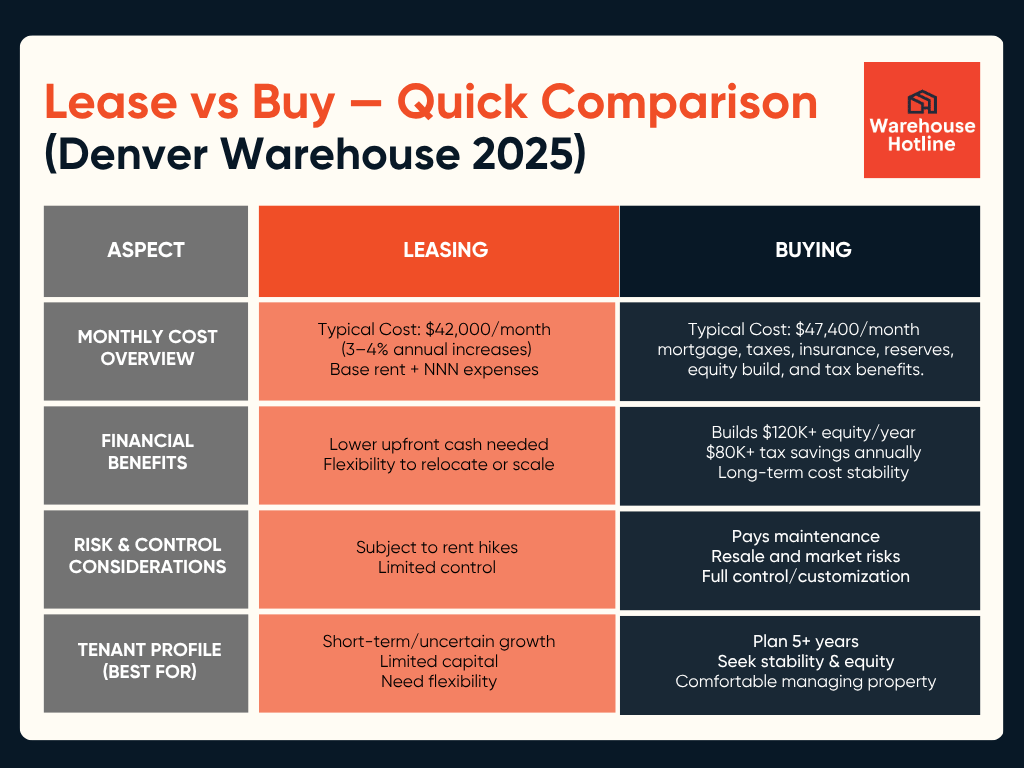
This side-by-side breakdown highlights key factors and trade-offs tenants should weigh. Use these insights to make a well-informed, strategic decision about whether leasing or owning a warehouse is right for your business.
Action: Try the Lease vs Buy Approach
Tenants can’t afford guesswork when it comes to understanding the true cost to own a warehouse in Denver. Before signing another lease renewal, it’s worth running your own Lease vs Buy analysis to see how ownership could impact your monthly costs and long-term equity.
Here’s how to approach it:
1. Define Your Basics → Start by outlining your square footage needs, preferred submarket (Aurora, Montbello, Central Denver, etc.), and working budget.
2. Explore Financing Options → Compare SBA 504 loans, conventional financing, and cash purchases. Look at how each affects monthly payments, down payments, and long-term equity buildup.
3. Model Market Scenarios → Incorporate realistic assumptions — rent escalation, interest rates, and vacancy trends — to reflect Denver’s industrial market dynamics.
4. Evaluate Risk Factors → Consider maintenance, resale timing, and liquidity. Ownership can strengthen stability, but only if the property aligns with your business’s operational and financial needs.
5. Project Long-Term Outcomes → Run the math over 5, 10, and 15 years to see how the cost to own a warehouse in Denver compares to renting — factoring in tax advantages, equity growth, and potential appreciation.
With this framework, you can move beyond short-term lease considerations and make decisions that balance cash flow today with long-term control and value growth tomorrow.
Q1: What is the average cost to own a warehouse in Denver?
A1: Costs vary by submarket, but ownership typically ranges $90–$120/SF depending on financing and property class.
Q2: Is it cheaper to lease or buy in Denver?
A2: Leasing is cheaper at first, but the cost to own a warehouse in Denver often proves lower long-term due to equity and tax benefits.
Q3: What financing options are available for tenants who want to buy?
A3: SBA 504 loans are the most common, allowing 10–15% down payments.
Q4: What risks come with owning a warehouse?
A4: Risks include maintenance costs, property illiquidity, and potential market downturns.
Q5: How can I calculate if ownership is right for my business?
A5: Start by comparing your current lease costs with what ownership would look like using real Denver data — including property prices, financing options, and taxes. Warehouse Hotline can help you model both scenarios side by side so you can see the long-term impact on cash flow, equity, and flexibility.
Follow Aviva and The Warehouse Hotline for exclusive insights, expert tips, and behind-the-scenes content on
- Website: The Warehouse Hotline
- TikTok: @avivarealestate
- Instagram: @avivarealestate
- X (Twitter): Aviva – Denver – Warehouse
- Facebook: Aviva Sonenreich’s Denver Commercial Real Estate | Warehouse Hotline
- LinkedIn: Aviva Sonenreich | Warehouse Hotline
- CRE Secrets: Spotify | Apple | Website
Don’t guess on your biggest real estate decision. Connect with Warehouse Hotline to calculate your exact cost to own a warehouse in Denver and compare it to leasing.
Sources
- CBRE Denver Industrial Figures Q2 2025
- Cushman & Wakefield Denver Industrial Report Q2 2025
- Matthews Denver Industrial Market Report Q2 2025
- LoopNet Denver Warehouse Listings (For Sale)