
2025 Market Shifts Highlight the Need for Early 2026 Positioning
Denver warehouse financing in 2025 faced a perfect storm of challenges. Elevated interest rates, tighter lender scrutiny, and more conservative underwriting created a selective lending environment.
Federal policy changes can influence economic conditions broadly, but there is no direct evidence tying any specific policy action to Denver warehouse financing in 2025. Additionally, the historic 43-day federal government shutdown from October through November 2025 caused temporary delays in federal economic data releases, SBA processing, and other regulatory approvals that lenders rely on for underwriting and credit decisions.
While these disruptions did not permanently alter the market, they highlighted how quickly lending conditions can shift — and how important readiness has become.
For Denver warehouse investors, understanding how lenders respond to both macroeconomic pressures and short-term disruptions underscores why positioning early for 2026 financing is now essential.
Problem: Denver Warehouse Financing Is Tightening Before 2026
Denver warehouse financing did not collapse in 2025; instead, lenders changed how they evaluate risk.
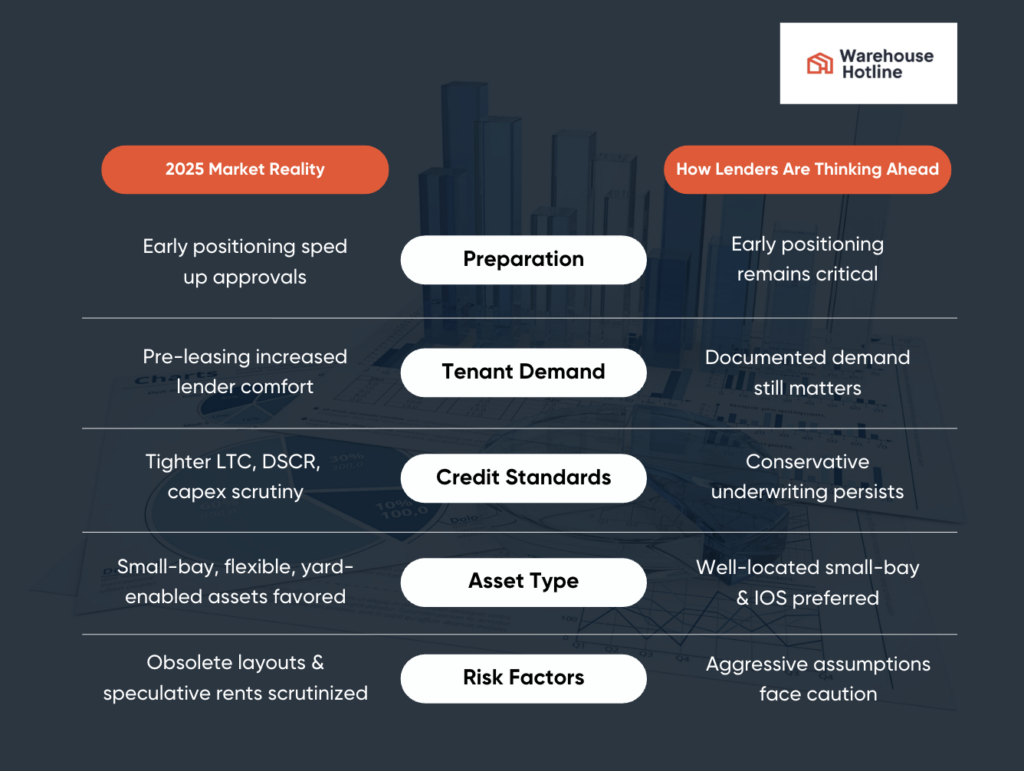
Interest rates remained elevated, but the more meaningful shift was a pullback in lender flexibility. Credit committees became more conservative, and underwriting assumptions that once passed easily began receiving closer scrutiny, especially on deals involving:
- Vacancy
- Significant capital expenditures
- Aggressive rent-growth projections
- Specialized or outdated layouts
As a result, financing outcomes across Denver’s industrial market have become uneven. Some investors are still closing efficiently, while others struggle to get term sheets finalized.
The difference is no longer just pricing. It’s preparation.
And heading into 2026, that gap is widening.
What changed in 2025, and how lenders are already thinking about 2026, can be summarized clearly:
Solution: Position for Financing the Way Lenders Are Already Thinking About 2026
Investors who are preparing now, rather than waiting for hypothetical rate cuts, are aligning their deals with how lenders expect credit to behave over the next 12 to 24 months. This means focusing on real income stability, credible tenant demand, and underwriting assumptions that reflect risk tolerances trending tighter.
Rather than asking, “Will financing get easier next year?” the smarter question is:
“What do lenders want to see today that makes underwriting smoother tomorrow?”
This mindset shift — from passive optimism to proactive positioning — is becoming the difference between stalled deals and successful closings.
Proof: How Lenders Are Rewarding Early Positioning
The lenders preparing their 2026 books of business are not publishing specific allocation data — but their current underwriting behavior is already signaling clear preferences. Here’s what we’re seeing in Denver industrial financing:
1. Early Positioning Gains Capital Advantage
While lenders aren’t releasing formal 2026 exposure plans, borrowers who come prepared today are getting meaningfully better outcomes. Clean underwriting packages, realistic income assumptions, and documented tenant interest are leading to faster credit committee movement and fewer late-stage hurdles.
The divergence is becoming clear:
Early positioning — not timing interest rate cycles — is emerging as the most reliable driver of financing success.
2. Pre-Leasing Is Critical
In Denver’s warehouse market, even partial pre-leasing materially improves how lenders view risk. Signed LOIs, tenant demand data, and evidence of lease-up activity allow lenders to model shorter downtime and more predictable cash flow.
Fully vacant assets without documented demand are facing sharper scrutiny as underwriting remains conservative.
3. Credit Is Tightening Selectively
Credit hasn’t disappeared, but it is narrowing in very specific ways. Today’s underwriting places greater emphasis on:
- Conservative loan-to-cost ratios
- Stronger DSCR assumptions
- Lower tolerance for deferred maintenance
- Skepticism toward speculative rent growth without tenant commitments
Borrowers who anticipate these constraints early experience smoother execution. Those who don’t often face last-minute pricing changes or capital stack adjustments.
4. Assets That Underwrite Well
Across Denver and Commerce City, lenders are showing consistent preference for:
- Small-bay industrial buildings
- Fenced and secured yard / IOS components
- Clean industrial zoning and adaptable, functional layouts
These assets align with tenant demand and produce more predictable underwriting outcomes — making approvals more straightforward.
5. Assets Facing Financing Challenges
As standards tighten, certain profiles are encountering resistance:
- Obsolete floorplans or low clear height
- Zoning ambiguities or special-use restrictions
- Underwriting dependent on aggressive rent growth without tenant backing
Lenders are increasingly asking one central question:
Who will occupy this warehouse, and how quickly?
If that answer is unclear, financing becomes significantly more complex.
Action: Secure Your Position Now
Investors who position early are the ones who will successfully secure Denver warehouse financing in 2026. By documenting tenant demand, preparing underwriting packages, and aligning asset characteristics with lender priorities, sponsors can reduce friction and avoid missed opportunities.
The Warehouse Hotline works directly with Denver investors to position assets for 2026 financing—before lenders set stricter exposure limits.
Q1: How long was the 2025 government shutdown and how did it impact CRE?
A1: The 43-day shutdown delayed permits, economic data, and federal approvals, highlighting market volatility that lenders consider in underwriting Denver warehouse financing.
Q2: What types of warehouses are easiest to finance in Denver?
A2: Small-bay industrial, facilities, fenced-yard properies, and properties with flexible layouts and clear zoning.
Q3: Does pre-leasing improve financing outcomes?
A3: Yes. Even partial pre-leasing demonstrates income stability and reduces plenders’ perceived risk
Q4: Are interest rates the main factor for Denver warehouse financing?
A4: Rates matter, but asset quality, tenant demand, and underwriting clarity are now more decisive for lenders heading into 2026.
Q5: When should investors start positioning for 2026 financing?
A5: Immediately. Early positioning aligns assets with lender priorities before exposure limits tighten.
Follow Aviva and The Warehouse Hotline for exclusive insights, expert tips, and behind-the-scenes content on
- Website: The Warehouse Hotline
- Youtube: Aviva Real Estate
- TikTok: @avivarealestate
- X (Twitter): Aviva – Denver – Warehouse
- Facebook: Aviva Sonenreich’s Denver Commercial Real Estate | Warehouse Hotline
- LinkedIn: Aviva Sonenreich | Warehouse Hotline
- CRE Secrets: Spotify | Apple
Sources:
Federal Shutdown & Macroeconomic Disruptions
- Shutdown Impact Disrupts CRE Operations – CRE Daily
- Government Shutdown Hits CRE Hard – CRE Daily
- Federal Government Shutdowns: Effects and Operations – Congressional Research Service
CRE Lending Conditions & Credit Tightening
- Commercial real estate lending trends – CBRE (2025)
- CRE market sentiment dropped by most in Q1 since pandemic (Reuters)
- US regional banks weather CRE storm, office loans continue to lag (Reuters)
Capital Markets & Underwriting Behavior
- Navigating Challenges in the 2025 CRE Lending Market – Worth Avenue Capital
- U.S. CRE Capital Markets Outlook (Q3–Q4 2025) – Sterling Asset Group
Industrial & Warehouse Market Insights